TL;DR:
- Scalable team extension integrates vetted external professionals into existing workflows for flexible scaling.
- It offers faster, cost-effective growth with deep cultural and operational alignment.
- Suitable for industries with compliance needs and fluctuating workloads, but requires structured onboarding and governance.
Most operations leaders assume that scaling a team means a drawn-out hiring cycle, a bloated headcount, or a loss of control over quality and culture. That assumption is costly. The reality is that scalable team extension gives you a third path: integrating vetted external professionals directly into your existing workflows, on your terms, at the pace your business demands. This guide breaks down exactly what scalable team extension is, how it works in practice, what it delivers in measurable terms, where it falls short, and when it is the right call for healthcare, legal, and eCommerce operations.
Table of Contents
- What is scalable team extension?
- How the scalable team extension model works
- Key benefits: Faster results, lower costs, and flexibility
- Risks, limitations, and how to avoid common pitfalls
- Why integration, not just outsourcing, matters most in scaling teams
- Boost your team’s performance with proven extension solutions
- Frequently asked questions
Key Takeaways
| Point | Details |
|---|---|
| Integrated specialist teams | Scalable team extension brings third-party talent into your in-house workflow for seamless collaboration. |
| Faster, more flexible scaling | You can achieve results 30-40% faster at half the cost of traditional full-time hiring, flexing team size as needed. |
| Risk management is crucial | Ensure success by addressing communication, culture fit, and onboarding with nearshore or structured approaches. |
| Not for every situation | Avoid this model for short-term needs or when you lack an in-house team foundation. |
What is scalable team extension?
With the stage set, let’s break down exactly what scalable team extension means and how it differs from more familiar models.
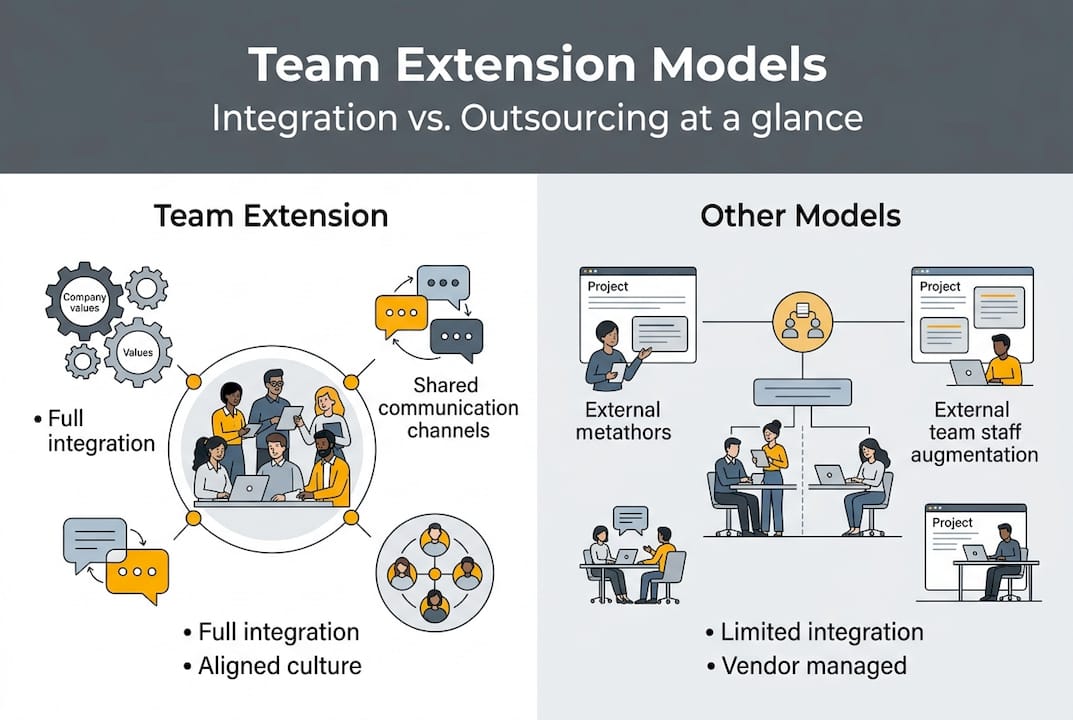
Scalable team extension is a staffing model where external professionals from a third-party provider are integrated directly into an existing in-house team to augment capacity, fill skill gaps, and enable flexible scaling without full-time hiring overhead. The key word here is integrated. These aren’t contractors working in a silo. They participate in your standups, your workflows, your tools, and your performance goals. They operate as an extension of your core team, not alongside it.
This distinction separates team extension from the two models most leaders are familiar with: outsourcing and staff augmentation.
How these models compare
| Feature | Team extension | Outsourcing | Staff augmentation |
|---|---|---|---|
| Integration level | Full workflow integration | Low, vendor manages output | Moderate, role-specific |
| Management control | High, client-led | Low, vendor-led | Moderate |
| Team alignment | Deep cultural and process fit | Minimal | Limited |
| Best for | Long-term, scalable growth | Defined, project-based output | Single-role gap filling |
| Flexibility | High, scale up or down | Low to moderate | Moderate |
The table above makes the operational difference clear. Outsourcing hands over a deliverable. Staff augmentation fills a seat. Team extension builds capacity. That distinction matters enormously when your healthcare operation needs compliant patient support at scale, or your eCommerce platform needs to manage seasonal spikes without burning out your core staff.
Where scalable team extension excels:
- Rapid scaling needs tied to growth, product launches, or seasonal demand
- Specialized talent gaps in areas like healthcare compliance, multilingual legal intake, or eCommerce platform support
- Long-term operational continuity where turnover risk must stay low
- Workloads that fluctuate and don’t justify permanent headcount
“Scalable team extension isn’t a staffing shortcut. It’s a strategic model for building operational capacity while preserving the cohesion and accountability of an in-house team.”
Understanding the team extension benefits from a cost and performance standpoint helps clarify why this model is gaining traction across industries with high compliance and quality demands. The model works because it respects something traditional outsourcing ignores: your workflows, your culture, and your quality standards are assets that need to be protected even as you grow.
How the scalable team extension model works
With a firm grasp on what team extension is, the next logical question is: how does it actually come together in practice?
The process is structured, not improvised. Mechanics involve identifying needs, selecting a partner, sourcing vetted talent, structured onboarding using 30-60-90 day plans with shadowing and supervised work, integration into workflows and tools, and ongoing governance with KPIs like CSAT, FCR, AHT, and SLA adherence. Each phase has clear ownership and defined milestones.
The step-by-step process looks like this:
- Needs analysis. Define the exact roles, skills, and capacity gaps. Be specific about compliance requirements (HIPAA for healthcare, data handling for legal), communication standards, and tool environments.
- Partner selection. Choose a provider with industry-specific experience, a proven vetting process, and nearshore cultural alignment. Generic staffing agencies rarely cut it for complex CX environments.
- Talent sourcing and vetting. The provider sources candidates against your defined criteria. Vetted candidates are reviewed, often with client input on final selection.
- Structured onboarding. The 30-60-90 day plan is not optional. The first 30 days focus on shadowing and observation. Days 31 through 60 introduce supervised independent work. By day 90, the team member is operating at full performance benchmarks.
- Workflow and tool integration. Extension professionals work inside your CRM, ticketing systems, communication platforms, and quality frameworks. There is no “vendor silo.”
- Ongoing KPI governance. Performance is measured continuously. CSAT scores, first contact resolution rates, average handling time, and SLA adherence are tracked and reviewed in structured cadences.
Roles and responsibilities at each stage
| Stage | Client responsibilities | Provider responsibilities |
|---|---|---|
| Needs analysis | Define scope, KPIs, tools | Consult on feasibility and fit |
| Talent sourcing | Review finalists, set criteria | Source, screen, and vet candidates |
| Onboarding | Assign internal mentor, share documentation | Coordinate logistics, manage timeline |
| Integration | Grant system access, align culture | Support ramp-up, handle admin |
| Governance | Review KPI dashboards, give feedback | Report performance, flag issues |
Reviewing integration best practices and scaling strategies early in the planning phase helps teams avoid the most common friction points before they arise.
Pro Tip: The quality of your onboarding documentation is directly proportional to how fast your extension team reaches full performance. If your internal team can’t find the answer in 30 seconds, your extension team won’t either. Audit your process guides, escalation trees, and FAQ libraries before your first extension hire arrives.
Key benefits: Faster results, lower costs, and flexibility
Now that you know the mechanics, let’s see why this model is winning converts among operations and CX leaders.
The numbers are compelling. Team extension delivers 30-40% faster delivery at roughly half the cost of a full-time equivalent, with the flexibility to scale up or down by project phase and access to niche skills without the typical 3-6 month hiring cycle. For a healthcare organization managing enrollment surges or a legal firm handling discovery intake, that speed and cost advantage is transformative.
The core operational benefits include:
- Cost efficiency. Extension professionals in nearshore markets typically cost 40-55% less than domestic FTEs when you factor in salary, benefits, taxes, office space, and recruitment overhead. The savings don’t come at the expense of quality when the model is implemented correctly.
- On-demand scalability. You can increase team capacity for a product launch or peak season and scale back without layoffs, severance costs, or the reputational risk that comes with workforce reduction.
- Access to specialized talent. Need a team fluent in eCommerce platform tools? Multilingual agents for a legal intake line? HIPAA-trained support specialists? A strong extension partner can source these profiles far faster than internal recruiting.
- Reduced time to productivity. Structured onboarding and pre-vetted talent mean extension professionals are contributing meaningfully within weeks, not months.
- Real KPI impact. Organizations using integrated CX efficiency models report measurable improvements in CSAT, FCR, and AHT. These aren’t theoretical gains. They appear in quarterly business reviews and customer satisfaction surveys.
Consider a mid-sized eCommerce retailer managing 15,000 contacts per month. During peak season, that volume triples. Hiring 30 full-time agents for a 90-day spike is financially irrational. Extending the team with 30 vetted, onboarded professionals who already know the platform is how scaling without sacrificing quality becomes operationally realistic.

The same logic applies to healthcare. Patient support teams face compliance requirements that narrow the talent pool significantly. Extension models allow healthcare organizations to access pre-trained, compliance-aware professionals without absorbing the full cost of permanent headcount. And scalable customer support done right protects both patient experience and regulatory standing.
Pro Tip: To measure ROI accurately, calculate the true cost of a domestic FTE including recruitment, onboarding, salary, benefits, and attrition replacement, then compare it against the total cost of your extension engagement including management overhead. Most organizations undercount FTE costs by 20-30%, which makes the extension ROI look stronger in retrospect than it appeared on paper at the start.
Risks, limitations, and how to avoid common pitfalls
But who should proceed cautiously, and where does team extension break down? This section delivers the practical downsides and how to mitigate them.
Team extension is not the right answer for every situation. The model isn’t suitable for short-term engagements of less than one full operational cycle or for organizations that lack an existing in-house team. Without an internal team to integrate with, the model loses its structural foundation. You need an anchor.
Common risks and how to address them:
- Communication barriers. Time zone misalignment and language differences can create friction. Nearshore partnerships reduce both risks significantly because they operate in overlapping business hours and share cultural context with North American teams.
- Cultural misalignment. Extension professionals who don’t connect with your brand values or communication norms underperform quickly. A cultural assessment during the partner selection phase is not optional. It’s foundational.
- Onboarding friction. Rushing the ramp-up phase is the most common mistake operations leaders make. A compressed onboarding timeline saves time on paper and costs significantly more in error rates, escalations, and early attrition.
- KPI drift. Without structured governance, extension teams can drift from performance standards over time. Regular performance reviews, clear KPI dashboards, and escalation protocols keep accountability visible.
- Scope creep. Extension teams sometimes absorb tasks outside their defined scope, which dilutes focus and inflates costs. Clear role definitions and change management protocols prevent this.
“The biggest failure mode in team extension isn’t the talent. It’s the absence of structured governance and genuine integration on the client side.”
Reviewing a concrete nearshore team integration example helps ground these risks in real operational context. It’s also worth revisiting your integration and measurement framework regularly, not just at launch.
When to choose a different model:
- Very short-term needs under 60 days: Standard staff augmentation is faster and more cost-effective.
- Fully independent project delivery with no internal collaboration: A dedicated outsourced team or project-based vendor is more appropriate.
- Single-role gaps with no scale expectation: Staff augmentation handles this more cleanly than a full extension model.
Knowing when not to use team extension is as important as knowing when to use it. The organizations that get the most value from this model are those that enter it with realistic expectations, a mature onboarding infrastructure, and a genuine commitment to treating extension professionals as part of the team.
Why integration, not just outsourcing, matters most in scaling teams
Having explored both the advantages and pitfalls, here is a candid take on why integrated teams, not classic outsourcing, are the real driver of scalability.
The CX and tech industries approach this question from different angles, but they arrive at the same answer. Both perspectives agree that integration is the core differentiator between genuine scalability and vendor dependency. Tech teams focus on speed and cost. CX leaders focus on compliance, quality, and CSAT outcomes. What neither can afford is a model where the external team operates independently of performance feedback loops.
The mistake most organizations make is treating team extension as a procurement decision rather than an operational one. They evaluate cost per seat and time to hire, then hand over an SLA document and expect results. That approach produces vendor relationships, not team extensions. And vendor relationships don’t move your CSAT scores.
Cultural fit is not a soft metric. In healthcare intake or legal support environments, a misaligned agent can create compliance exposure, patient complaints, or case errors that cost far more than the per-hour savings. Nearshore models reduce this risk by providing professionals who share time zones, communication norms, and business culture with your core team.
The organizations seeing the biggest gains from CX success with team extension treat their extension professionals with the same investment they give internal staff. Shared goals. Real feedback. Genuine inclusion in team culture. That’s not sentiment. That’s operational strategy.
Boost your team’s performance with proven extension solutions
Ready to move from strategy to execution? Altiam CX helps operations and CX leaders in healthcare, legal, and eCommerce build high-performing, integrated teams without the overhead of full-time hiring.

Our nearshore CX solutions are built on the same integration principles this article covers: structured onboarding, cultural alignment, measurable KPI governance, and genuine operational partnership. We don’t just fill seats. We extend your team’s capability in ways that show up in your performance data. Explore our nearshore team extension case study to see how real organizations have scaled efficiently, or visit Altiam CX to learn more about our full range of team extension solutions and how we can support your next growth phase.
Frequently asked questions
How does scalable team extension differ from traditional staff augmentation?
Scalable team extension integrates external professionals directly into in-house workflows, culture, and governance structures, while staff augmentation typically places individuals in single roles without the same depth of workflow or cultural integration.
What KPIs are essential for managing a scalable team extension model?
Key performance indicators include customer satisfaction score (CSAT), first contact resolution (FCR), average handling time (AHT), and SLA adherence, all tracked through structured governance cadences.
When is team extension not the right solution?
Team extension isn’t appropriate for very short-term projects under one operational cycle or for organizations that have no existing in-house team to integrate with, since the model depends on that internal anchor.
Which industries gain the most from scalable team extension?
Industries with complex compliance requirements and variable workloads including healthcare, legal, and eCommerce consistently see the greatest operational and financial returns from a well-structured team extension model.