
TL;DR:
- Omnichannel support unifies all communication channels for seamless, context-aware customer experiences.
- It significantly improves customer loyalty and operational efficiency by reducing redundancy and increasing personalization.
- Successful implementation requires deliberate technology integration, process standardization, team training, and often benefits from nearshore outsourcing partners.
Fragmented customer interactions are one of the most persistent frustrations facing operational leaders today. A customer emails your team, follows up on chat, and then calls in, only to repeat their issue from scratch every single time. That is not a service problem. That is a structural problem. Omnichannel support is the strategic answer, unifying every touchpoint into a single, coherent experience that serves customers without friction and positions your organization for scalable, sustainable growth. This guide breaks down exactly what omnichannel support is, why it matters, how to build it, and how nearshore partnerships accelerate results.
Table of Contents
- What is omnichannel support?
- Why omnichannel support matters for customer experience
- Key components of a successful omnichannel strategy
- Omnichannel support in action: use cases and real-world examples
- The uncomfortable truth about omnichannel support most leaders miss
- Elevate your customer experience with Altiam CX
- Frequently asked questions
Key Takeaways
| Point | Details |
|---|---|
| Omnichannel defined | Omnichannel support connects every customer interaction channel for seamless service. |
| Customer experience impact | Organizations using omnichannel support see higher retention and satisfaction. |
| Strategic implementation | Success requires the right tech, team processes, and ongoing alignment. |
| Real-world results | Industries from law to tech benefit by adopting best practice omnichannel models. |
What is omnichannel support?
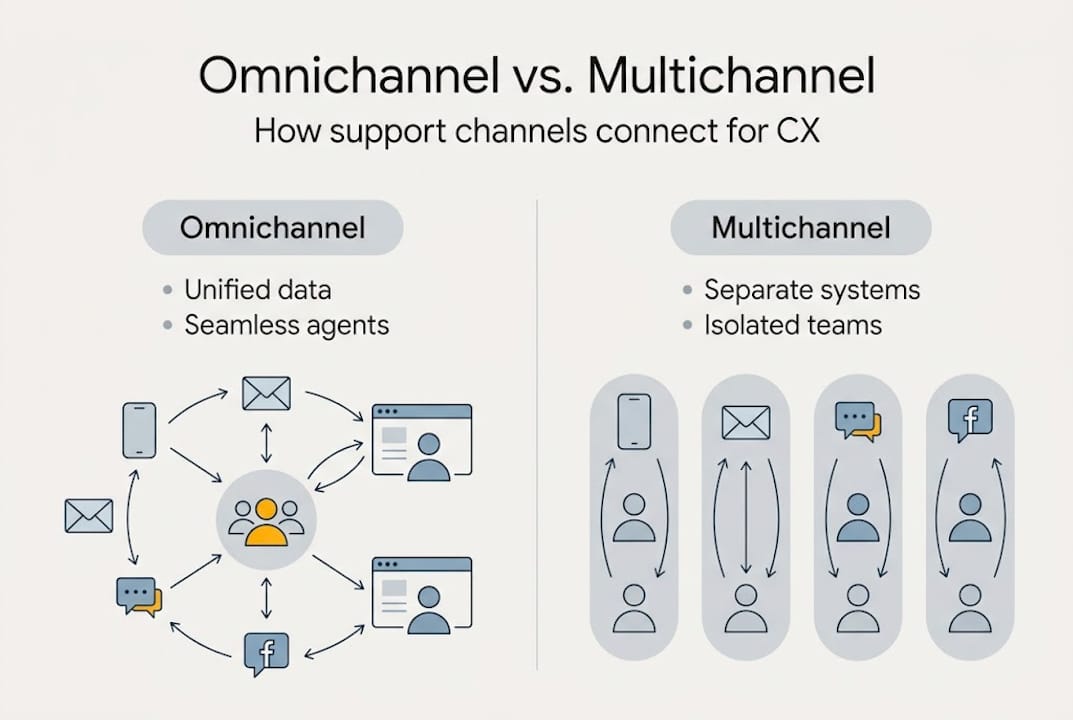
Omnichannel support is a customer service model that integrates all communication channels into one seamless, connected experience. It does not just open multiple contact points for customers. It links them together so that context, history, and customer data flow continuously across every interaction, regardless of the channel used.
Here is why this distinction matters. Many organizations operate a multichannel model, which simply means they are reachable through several channels. That is a good start, but it is not enough. In a multichannel setup, each channel operates independently. An agent on chat has no visibility into what a customer said on the phone yesterday. The result is redundancy, frustration, and eroded trust.
Omnichannel changes the architecture entirely. Every channel communicates with a shared data layer, so agents always see the full picture. Customers never repeat themselves. And service feels coherent rather than chaotic.
Omnichannel vs. multichannel: a clear comparison
| Feature | Omnichannel | Multichannel |
|---|---|---|
| Channel integration | Fully unified | Separate and siloed |
| Customer data sharing | Real-time, across all channels | Limited or manual |
| Agent visibility | Complete interaction history | Single-channel view |
| Customer experience | Seamless and consistent | Disjointed |
| Scalability | High | Moderate |
Common channels unified in an omnichannel strategy
A robust omnichannel strategy typically connects the following touchpoints into one integrated environment:
- Email for detailed inquiries and follow-ups
- Live chat for immediate, real-time support
- Phone for high-stakes or complex conversations
- Social media for public-facing engagement and fast responses
- Messaging apps such as WhatsApp or SMS for mobile-first customers
- In-app support for product-embedded assistance
- Self-service portals and knowledge bases for autonomous resolution
The goal is not to be present on every channel. The goal is to make those channels work together. When a customer switches from chat to a phone call, the agent answering should already know the context of that chat conversation. That is context-aware service, and it is the hallmark of a mature CX operation. Organizations that achieve this consistency build stronger customer relationships, reduce handle time, and improve both agent efficiency and customer satisfaction simultaneously.
Why omnichannel support matters for customer experience
Customer loyalty is not won in a single interaction. It is built across dozens of touchpoints over time. When those touchpoints feel disconnected, customers lose confidence in your organization and start looking elsewhere. When they feel unified, customers stay, spend more, and refer others. The business case is straightforward.
Organizations with omnichannel strategies retain 89% of their customers, compared to just 33% for companies with weak omnichannel engagement. That gap is not marginal. It represents a fundamental difference in how customers experience your brand over time.
“Consistency across every channel is not a luxury. It is the baseline expectation of today’s customer.”
Consider a practical scenario. A retail customer orders a product online, receives a defective item, and reaches out via chat. The agent resolves the issue but the customer later follows up on social media because the replacement was delayed. If the social media team has zero visibility into the original chat resolution, the customer must explain everything again. That friction creates a negative experience at exactly the moment the customer needed reassurance.

Now flip that scenario. With omnichannel support, the social media agent immediately sees the prior chat, the resolution, and the replacement order status. The response is fast, informed, and empathetic. That interaction strengthens the relationship. The customer sees a team that is organized, attentive, and capable. That perception translates directly into loyalty, repeat purchases, and referrals.
To improve customer support at this level, data plays a central role. Organizations that leverage customer interaction data across channels can personalize responses, anticipate needs, and reduce escalations before they happen.
Pro Tip: Connect your CRM, helpdesk, and analytics platforms so that every agent interaction feeds a shared intelligence layer. This is the foundation of true omnichannel personalization and one of the highest-leverage investments your CX leadership can make.
The impact extends beyond customer satisfaction scores. When agents have context, they resolve issues faster. When resolution is faster, handle time drops and capacity increases. When capacity increases, you can serve more customers without proportionally growing your team. The operational efficiency gains are significant and compound over time.
Key components of a successful omnichannel strategy
Knowing what omnichannel support is and why it matters is only the beginning. Operationalizing it requires deliberate architecture across technology, process, and team alignment. Many organizations underestimate this complexity, which is why well-intentioned omnichannel initiatives stall before they deliver value.
Integrating technology and aligning processes are not optional considerations in omnichannel strategy. They are prerequisites. Without both, you end up with more channels and more confusion, which is worse than where you started.
Core omnichannel components
| Component | Description | Why it matters |
|---|---|---|
| Unified platform | CRM or helpdesk connecting all channels | Single source of truth for agent and customer |
| Data integration | Real-time sync of customer data across channels | Enables context-aware interactions |
| Process documentation | Standardized workflows for each channel | Reduces inconsistency and escalation |
| Analytics and reporting | Cross-channel performance tracking | Identifies gaps and improvement opportunities |
| Team alignment | Trained agents who can work across channels | Ensures consistent tone, quality, and execution |
Building your omnichannel strategy: step by step
A structured approach prevents the most common failure modes. Here is a proven sequence for leaders ready to move from concept to execution:
- Audit your current channels. Identify which channels you operate, how they are managed, and whether they share data. Map the gaps.
- Choose a unified platform. Select a CRM or helpdesk tool that natively integrates with all your active channels. Prioritize platforms with strong API connectivity for future expansion.
- Standardize your processes. Define clear escalation paths, response time standards, and agent protocols for each channel. Processes should be consistent even when channels vary.
- Integrate your data systems. Connect your CRM, ticketing system, and analytics platforms so that interaction history flows freely across tools and agents.
- Train your team. Technology without trained people fails. Invest in agent enablement so that your team knows how to use the unified platform, interpret customer history, and maintain consistent communication quality.
- Measure and iterate. Set clear KPIs across channels, including first contact resolution, average handle time, and CSAT scores. Use analytics to spot problems early and refine continuously.
One of the most critical and often underestimated steps is step five. Technology decisions are easier to make than cultural and behavioral change. Agents accustomed to working in a single-channel environment need time, coaching, and incentive alignment to thrive in a context-aware, multi-channel model. Leaders who invest in that transition see dramatically better outcomes than those who simply implement new tools and assume adoption will follow naturally.
For scalable customer support, the architecture must be designed with growth in mind from day one. Platforms that cannot scale alongside your customer base will create bottlenecks exactly when demand peaks. Plan for volume surges, seasonal spikes, and new channel additions before they become emergencies.
Omnichannel support in action: use cases and real-world examples
Strategy becomes credible when you see it applied. Across industries, organizations are deploying omnichannel support not as a theoretical ideal but as an operational reality that solves specific business problems. Here are several patterns worth understanding.
E-commerce: Online retailers face one of the highest volumes of customer inquiries, spanning order tracking, returns, product questions, and payment issues. An effective omnichannel operation connects chat, email, social, and phone so that a single customer thread can move across channels without data loss. Agents see purchase history, prior contact reasons, and resolution outcomes in real time. The practical result is faster resolution, lower repeat contact rates, and higher post-purchase satisfaction scores.
Technology companies: Software and SaaS providers often support customers across in-app chat, email, documentation portals, and community forums. When these channels share data, support teams can identify patterns such as a recurring bug generating high contact volume and escalate proactively to product teams. That connection between CX data and product improvement is a competitive advantage that pure multichannel setups cannot replicate.
Professional services: Professional service providers leverage omnichannel support to enhance client communication and satisfaction in ways that directly affect retention and referrals. Law firms, for instance, manage sensitive client communications across phone, email, and secure messaging. A unified support model ensures that intake agents, case managers, and administrative staff all operate from the same client interaction record, reducing miscommunication and improving client loyalty in legal settings significantly.
Best practices observed in high-performing omnichannel organizations
- Prioritize channel consistency in tone and resolution quality, not just channel availability
- Use tagging and categorization across every interaction to build searchable customer histories
- Assign channel specialists who own quality within a channel while still sharing data across the platform
- Create feedback loops between CX teams and product or operations teams so that contact patterns inform broader business decisions
- Conduct regular cross-channel audits to identify where customers are experiencing friction or channel-switching unnecessarily
Common pitfalls to avoid include launching channels without adequate staffing, implementing platforms without integration testing, and failing to define escalation protocols when customers move across channels. Each of these errors creates the very fragmentation that omnichannel is designed to eliminate.
Pro Tip: Nearshore outsourcing partners can accelerate your omnichannel deployment significantly. Experienced nearshore teams bring existing CX platform expertise, established training frameworks, and the cultural alignment needed to represent your brand effectively across channels from day one. Rather than building internal capacity from scratch, you can extend your team strategically and start seeing results in weeks rather than months.
The uncomfortable truth about omnichannel support most leaders miss
Here is what too many CX leaders discover only after a painful rollout: adding more channels without unified data and disciplined processes does not improve the customer experience. It fractures it further.
The instinct is understandable. You see customers using social media, messaging apps, and chat. You want to be there for them. So you open those channels, assign agents, and call it omnichannel. But if those channels do not share data, you have not built an integrated experience. You have built a more complex version of the same broken model.
True omnichannel support is an organizational capability, not a technology checkbox. It requires workflow redesign, cultural change, and ongoing performance management. The technology enables the strategy, but it cannot replace it.
This is also where the value of outsourcing customer experience to a nearshore partner extends far beyond cost savings. The best nearshore partners bring process maturity and platform expertise that most internal teams take years to develop independently. They are not just extra headcount. They are strategic extensions of your CX function that can help you operationalize the discipline omnichannel actually requires.
Leaders who treat nearshore partners as true strategic collaborators, sharing KPIs, customer insights, and business context, consistently outperform those who treat outsourcing as a transactional cost lever. That mindset shift is the real differentiator between organizations that build thriving omnichannel operations and those that simply add channels and hope for the best.
Elevate your customer experience with Altiam CX
Building a high-performing omnichannel support operation is achievable when you have the right partner in your corner.

Altiam CX helps mid-sized and large organizations design, staff, and scale seamless omnichannel CX programs using nearshore talent built for performance. Whether you need to extend your existing team or build new support capacity from the ground up, our proven frameworks and cultural alignment make the difference. Explore our nearshore team extension case studies to see how organizations like yours have achieved measurable CX transformation. Ready to take the next step? Visit our team extension services to see how Altiam CX can support your omnichannel strategy starting today.
Frequently asked questions
How is omnichannel support different from multichannel?
Omnichannel integrates all channels for a seamless experience where data flows continuously across touchpoints, while multichannel simply offers multiple contact options without connecting them to a shared customer record.
What are the biggest challenges in implementing omnichannel support?
The most common obstacles are technology integration, standardizing agent processes across channels, and maintaining consistent data quality. Integrating technology and aligning processes require deliberate planning and sustained leadership commitment to succeed.
What channels are typically included in omnichannel support?
Omnichannel strategies typically include email, live chat, phone, social media, SMS, messaging apps, in-app support, and self-service knowledge bases, all connected through a unified platform.
How does outsourcing help with omnichannel support?
Nearshore teams accelerate omnichannel deployment by providing immediate access to experienced talent, proven technology platforms, and established training frameworks that most internal teams would take considerably longer to build on their own.