
TL;DR:
- Effective patient support relies on integrating AI workflows, behavioral segmentation, and strong team communication protocols. These strategies improve adherence, reduce operational friction, and foster a culture of patient-centered care. Proper implementation depends on staff training, clear processes, and ongoing workflow adjustments.
Patient support, defined in healthcare operations as the coordinated system of clinical, administrative, and communication workflows that guide patients from enrollment through adherence, is the single greatest driver of therapy success or failure. Knowing how to streamline patient support means building a hybrid model where AI handles operational volume and trained staff focus on complex patient needs. The gap between a fragmented support system and an integrated one shows up directly in adherence rates, staff burnout, and patient satisfaction scores. This article gives healthcare providers and patient support managers a concrete framework to close that gap.
What tools and infrastructure do you need to streamline patient support?
The foundation of any efficient patient support system is interoperability. EHR integration via HL7-based standards like SCRIPT and the Surescripts Specialty Medications Gateway reduces manual administrative burden by connecting prescriber workflows directly to support hubs. Without that connectivity, staff spend hours on fax and phone follow-ups that should take minutes.

Electronic benefit verification and multi-channel enrollment shorten response cycles and reduce patient confusion by replacing traditional bottlenecks with digital channels. That shift alone frees case managers to spend time on patients who need real clinical guidance. AI tools further extend this capacity by handling eligibility checks, prior authorization tracking, and appointment reminders at scale.
The table below compares the core tools every patient support operation needs and what each one delivers:
| Tool | Primary function | Key benefit |
|---|---|---|
| EHR integration (HL7/SCRIPT) | Connects prescriber and support hub data | Eliminates manual data re-entry |
| AI benefit verification | Automates eligibility and prior auth checks | Reduces case manager workload |
| Multi-channel communication platform | Delivers SMS, voice, and digital outreach | Meets patients on preferred channels |
| Behavioral analytics engine | Segments patients by risk and engagement | Enables targeted, timely interventions |
| Ambient scribing tools | Captures clinical interactions in real time | Reduces documentation burden on clinicians |
Staff training completes the infrastructure picture. Technology without trained users produces inconsistent results. Patient support managers should build training programs that teach staff how to interpret patient feedback data and apply it to communication decisions, not just how to operate software.
- Prioritize EHR connectivity before adding AI tools. Disconnected systems create new friction points.
- Train staff on feedback integration, not just platform navigation.
- Establish clear escalation protocols so AI handoffs to human agents are smooth and context-rich.
- Audit communication channels quarterly to confirm patients are actually using them.
How to design a patient-centered workflow that combines AI and human expertise
Workflow design is where most patient support programs either succeed or fail. Effective hybrid systems assign AI to operational volume tasks and human experts to complex interactions, with full patient context transferred at every handoff. The critical mistake is designing handoffs that force patients to repeat their information. That single friction point destroys trust faster than any other failure.
AI tools improve medication adherence by 6.7% to 32.7% over standard practices. That range reflects how much design quality matters. A well-designed AI workflow captures the high end of that range. A poorly designed one captures the low end.
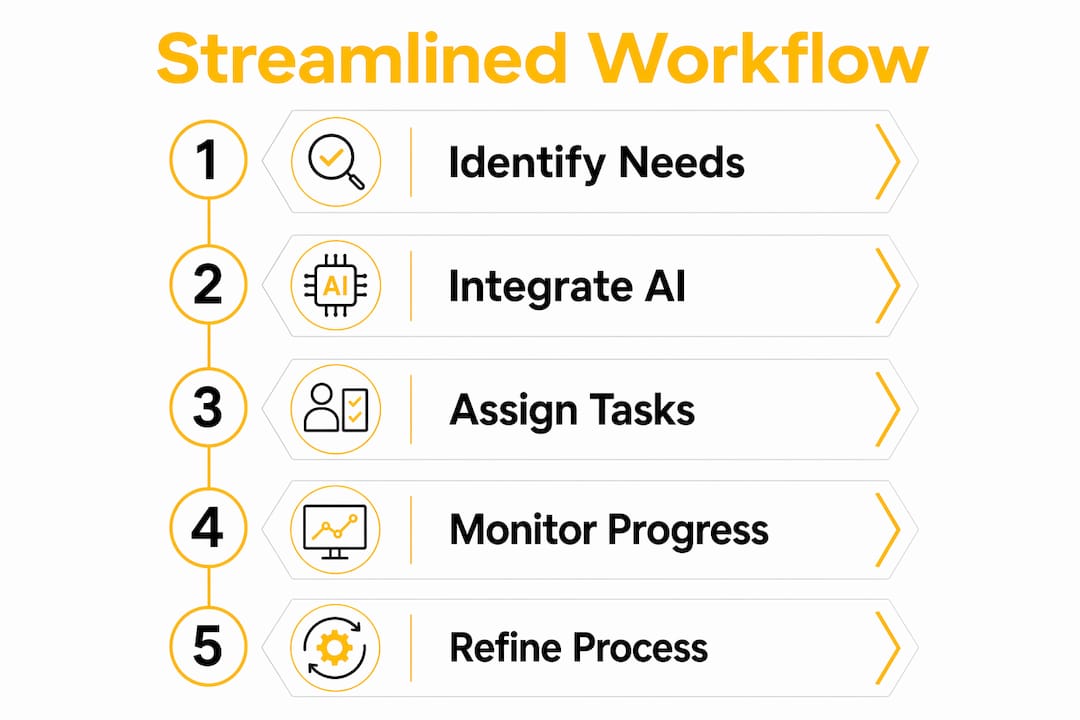
Follow these steps to build a workflow that delivers results:
- Map the patient journey from referral to adherence. Identify every touchpoint where patients currently experience delays or confusion.
- Assign AI to intake and eligibility tasks. Benefit verification, insurance checks, and enrollment forms are high-volume and rule-based. AI handles these accurately and quickly.
- Build behavioral segmentation into the enrollment stage. Classify patients by adherence risk, communication preference, and therapy complexity from day one.
- Design trigger-based escalation rules. When a patient misses a refill, skips an appointment, or goes silent, the system should automatically escalate to a human case manager with full context.
- Create a single patient record that both AI and human agents update. This prevents the repeated questioning that frustrates patients and wastes staff time.
- Set measurable success metrics for each workflow stage. Time to enrollment, first-fill rate, and 90-day persistence are the three metrics that matter most.
- Review and adjust workflows monthly. Patient-centered support programs that iterate based on defined success metrics consistently outperform static ones.
Pro Tip: Never ask a patient the same question twice. Build your CRM and AI platform so that every agent, human or automated, sees the full interaction history before making contact. This one rule eliminates more patient frustration than any other single change.
Behavioral segmentation deserves special attention. Uniform engagement cadences underdeliver because patients have different risk profiles and communication preferences. A patient who is newly diagnosed and cost-anxious needs different outreach than a patient who is six months into therapy and showing strong adherence. Designing for that difference is what separates a high-performing support program from an average one.
What are best practices for improving communication across clinical and non-clinical teams?
Team coordination is the most underrated factor in patient support quality. Clinician-led communication strategies that embed consistent messaging behaviors improve patient trust without adding documentation burden. The key is reinforcing those behaviors in real time, not just in quarterly training sessions.
Clinician training on patient feedback improves patient experience and reduces staff burnout simultaneously. That dual benefit matters because burnout is one of the top drivers of support program inconsistency. When staff understand how their communication choices affect patient outcomes, they engage more deliberately with every interaction.
Practical tactics for improving cross-team communication:
- Create shared communication protocols that define how clinical and non-clinical staff hand off patient information. Ambiguity at the handoff point is where messages get lost.
- Use ambient scribing tools to capture clinical conversations and flag communication gaps without adding charting time.
- Establish a patient experience feedback loop where frontline staff receive weekly summaries of patient satisfaction data tied to their specific interactions.
- Hold brief cross-department alignment meetings focused on active patient cases, not general process reviews. Fifteen minutes weekly beats a two-hour monthly meeting.
- Define escalation ownership clearly. Every patient issue should have one named owner at any given moment.
Pro Tip: Assign a patient experience lead in each department rather than centralizing all feedback review in one office. Distributed ownership creates faster response times and builds a culture where every team member feels accountable for patient outcomes.
Cross-department patient experience structures reduce operating costs by 1.4% yearly through improved communication and outcomes. That figure is modest in isolation, but it compounds across departments and years. The organizations that build these structures early gain a measurable efficiency advantage over those that treat patient experience as a separate function from operations.
Explore how healthcare customer care strategies connect communication best practices to measurable satisfaction outcomes.
How does proactive outreach reduce patient disengagement?
Early engagement is the highest-leverage activity in any patient support program. High-frequency outreach within the first 30 days, including nurse calls and SMS, is a key predictor of long-term persistence. Patients who receive consistent contact in the first month are significantly more likely to stay on therapy at 90 days and beyond.
AI analytics identify disengagement risk before it becomes dropout. Patterns like delayed refill requests, missed appointment confirmations, and reduced portal activity all signal that a patient needs proactive contact. Acting on those signals early costs far less than re-engaging a patient who has already stopped therapy.
The table below compares outreach methods by effort level and expected impact:
| Outreach method | Effort level | Best use case | Expected impact |
|---|---|---|---|
| Nurse phone call | High | Complex adherence issues, side effect concerns | Highest trust and retention |
| SMS reminder | Low | Refill reminders, appointment confirmations | High volume, fast response |
| Digital status update | Low | Enrollment progress, prior auth status | Reduces inbound call volume |
| Personalized education content | Medium | Risk-segmented patients with knowledge gaps | Improves informed adherence |
| AI-triggered escalation alert | Low | Disengagement pattern detection | Enables timely human intervention |
Behavioral segmentation with trigger-based outreach consistently outperforms uniform engagement cadences. Sending the same message to every patient at the same interval wastes resources and misses the patients who need attention most. Segmenting by risk level and adjusting outreach intensity accordingly is the practice that separates programs with strong persistence rates from those with chronic dropout problems.
For a deeper look at how back-office automation supports proactive outreach at scale, the operational mechanics are worth reviewing.
Key takeaways
Efficient patient support requires integrating AI-driven workflows, behavioral segmentation, and cross-team communication protocols to improve adherence and reduce operational friction.
| Point | Details |
|---|---|
| Build on interoperability first | Connect EHR systems via HL7/SCRIPT before adding AI tools to avoid creating new data silos. |
| Use AI for volume, humans for complexity | Assign AI to benefit verification and enrollment; reserve case managers for high-risk patient interactions. |
| Engage patients early and often | High-frequency outreach in the first 30 days is the strongest predictor of long-term therapy persistence. |
| Segment outreach by behavior and risk | Trigger-based, personalized contact outperforms uniform engagement cadences in adherence outcomes. |
| Train teams on feedback, not just tools | Clinician training on patient feedback data reduces burnout and improves patient satisfaction simultaneously. |
The part most healthcare teams get wrong
I have worked with enough patient support operations to know where the real breakdown happens. It is almost never the technology. The tools exist. EHR integration works. AI can handle benefit verification accurately. The breakdown happens in the space between systems and people.
Most teams implement a new platform and assume the workflow problem is solved. It is not. The workflow problem is a culture problem dressed up as a technology problem. Staff who do not understand why they are collecting patient feedback will not use it. Clinicians who feel surveilled by ambient scribing tools will resist them. Case managers who receive AI-generated escalation alerts without context will ignore them.
The organizations that actually improve patient support outcomes are the ones that invest as much in staff alignment as they do in software. They explain the “why” behind every new process. They create feedback loops that show frontline staff how their actions connect to patient outcomes. They treat patient experience data as a shared operational asset, not a compliance metric.
Technology enables scale. People deliver care. The best patient support programs do not choose between the two. They design systems where each one makes the other more effective. That is the standard worth building toward.
— Daniela
How Altiamcx helps healthcare providers build better patient support
Healthcare providers that want to move from fragmented support to an integrated, high-performing operation need more than a software upgrade. They need operational expertise, trained teams, and a performance framework that connects every activity to measurable outcomes.
Altiamcx partners with healthcare organizations to build patient support operations that combine AI-enabled workflows with experienced, culturally aligned teams. The results speak clearly: a productivity improvement of 89% in a documented case study shows what disciplined execution delivers. If you are ready to reduce friction, improve patient adherence, and build a support operation that scales, explore Altiamcx’s healthcare CX and operations solutions or request a consultation today.
FAQ
What does it mean to streamline patient support?
Streamlining patient support means redesigning workflows so AI handles routine tasks and trained staff focus on complex patient needs. The goal is faster service, fewer errors, and higher patient adherence.
How does AI improve patient support operations?
AI tools improve medication adherence by 6.7% to 32.7% over standard practices by automating eligibility checks, benefit verification, and risk-based outreach triggers. The gains depend heavily on how well the AI integrates with existing clinical workflows.
Why is early outreach so critical for patient persistence?
High-frequency contact within the first 30 days is a key predictor of long-term therapy persistence. Patients who receive consistent nurse calls and SMS reminders early in their therapy are far less likely to disengage.
What is behavioral segmentation in patient support?
Behavioral segmentation classifies patients by adherence risk, communication preference, and therapy complexity. Trigger-based outreach built on that segmentation consistently outperforms uniform engagement cadences.
How does team coordination affect patient support quality?
Clinician training on patient feedback reduces staff burnout and improves patient experience at the same time. Cross-department communication protocols and clear escalation ownership prevent the information gaps that lead to inconsistent patient care.