
TL;DR:
- High-touch customer care involves personalized, proactive human interactions focused on complex, high-value needs.
- It enhances healthcare outcomes and legal trust through empathy, tailored support, and strategic follow-up.
- Hybrid models combining high-touch with automation effectively balance quality and scalability across industries.
Many CX leaders assume high-touch customer care is too expensive or too slow to scale. That assumption is costing them. Across healthcare, eCommerce, and legal services, organizations that invest in personalized, human-centered support consistently outperform those that rely solely on automation. This guide cuts through the noise. You’ll get a clear definition of high-touch care, see how it plays out in three distinct industries, and walk away with practical strategies you can apply to your own operations. The goal is not to replace your current model but to sharpen it.
Table of Contents
- Defining high-touch customer care
- High-touch care in healthcare: Empathy and personalization
- High-touch client care in legal services: Trust and responsiveness
- Balancing high-touch with scalability: Hybrid models and tech
- Why true high-touch care is undervalued—and how to harness it
- Level up your customer care with expert CX solutions
- Frequently asked questions
Key Takeaways
| Point | Details |
|---|---|
| High-touch defined | High-touch customer care prioritizes personalized, empathetic, and high-value interactions. |
| Industry impact | Healthcare and legal sectors achieve stronger satisfaction and outcomes through high-touch strategies. |
| Hybrid advantage | Combining high-touch with scalable tech delivers better operational efficiency without compromising customer experience. |
| Evidence-driven ROI | Practical approaches prove that the right high-touch investments produce measurable returns in trust and retention. |
Defining high-touch customer care
High-touch customer care means every interaction is personalized, proactive, and handled by a skilled human who understands the customer’s full context. It is not just about being friendly. It is about knowing who your customer is, anticipating their needs, and responding with precision.
The contrast with low-touch or automated care is stark. Low-touch models prioritize speed and volume. They use chatbots, self-service portals, and standardized scripts to resolve common issues fast. High-touch models prioritize depth. They invest in relationship-building, complex problem-solving, and emotional intelligence.
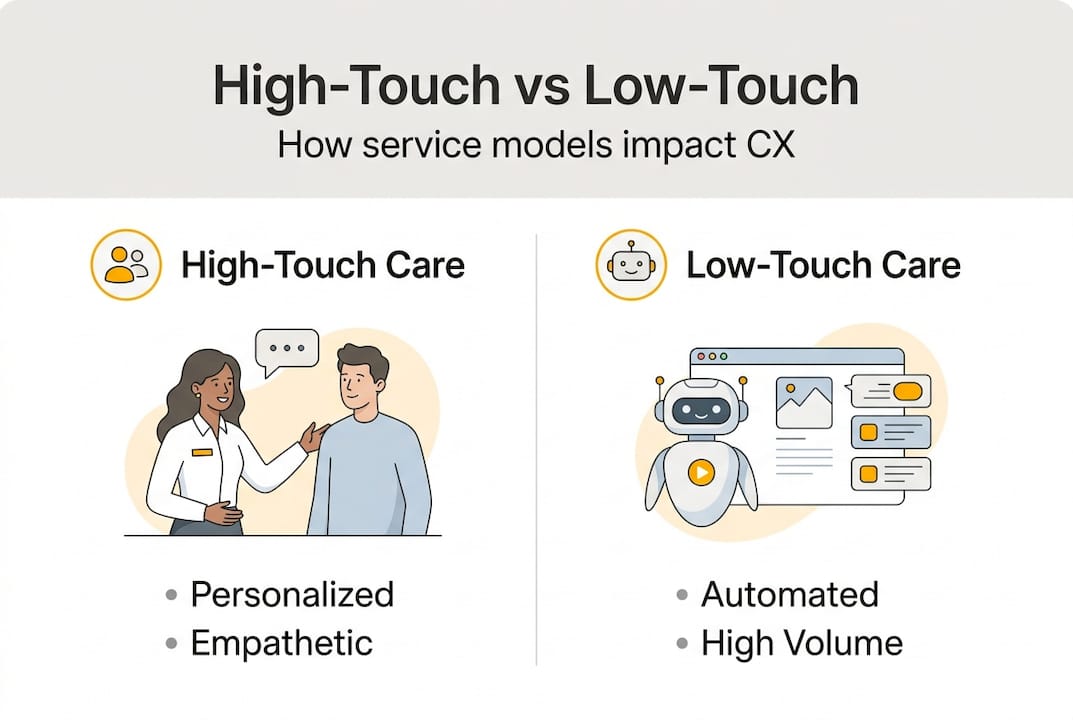
Here is a side-by-side comparison:
| Feature | High-touch care | Low-touch/automated care |
|---|---|---|
| Interaction style | Personalized, human-led | Standardized, automated |
| Best for | Complex, high-value cases | High-volume, routine queries |
| Cost per interaction | Higher | Lower |
| Customer satisfaction | Higher for complex needs | Sufficient for simple needs |
| Scalability | Limited without hybrid model | High |
Key principles of high-touch care include:
- Proactive outreach: Reaching out before the customer has to ask
- Contextual knowledge: Agents know the customer’s history and preferences
- Empathetic communication: Responses reflect genuine understanding, not scripted sympathy
- Accountability: One point of contact owns the resolution
- Follow-through: Interactions do not end at resolution; follow-ups confirm satisfaction
Understanding customer care fundamentals is the foundation before layering in high-touch strategies. Without that base, personalization feels hollow.
The trade-off is real. High-touch care costs more per interaction. It requires trained agents, longer handle times, and more robust customer care workflow strategies. But the return on complex and high-value interactions is measurable. According to research, high-touch care is best for complex scenarios and not scalable for volume-heavy, low-value interactions. That is exactly why hybrid models matter. Combining high-touch with AI-assisted triage gives you the best of both worlds without blowing your budget.
Pro Tip: Map your interaction types before choosing your model. If more than 30% of your volume involves complex decisions or emotional stakes, a hybrid approach with a strong high-touch layer will likely outperform a fully automated setup.
High-touch care in healthcare: Empathy and personalization
Healthcare is where high-touch care is not optional. Patients are not just customers. They are people navigating fear, uncertainty, and often life-altering decisions. Generic support fails them.
Leading healthcare organizations are building healthcare CX best practices around five core high-touch strategies:
- Frontline empathy training: Staff learn to recognize emotional cues and respond with genuine compassion, not rehearsed lines.
- Patient navigators: Dedicated contacts guide patients through complex care journeys, from scheduling to post-treatment.
- Personalized care plans: Each patient receives a tailored roadmap based on their diagnosis, preferences, and support system.
- Post-discharge follow-ups: Proactive calls or messages after discharge reduce readmissions and build trust.
- Community partnerships: Connecting patients with local resources addresses logistical and emotional needs beyond clinical care.
Research confirms that patient-centered approaches like these, including rapport-building and patient concierge programs, directly improve satisfaction scores and retention.
| Strategy | Impact area | Measurable outcome |
|---|---|---|
| Empathy training | Staff-patient interaction | Higher HCAHPS scores |
| Patient navigators | Care coordination | Reduced no-show rates |
| Post-discharge follow-ups | Recovery support | Lower readmission rates |
| Community partnerships | Holistic patient support | Improved long-term retention |
Organizations focused on enhancing patient outcomes consistently report that the relationship between care quality and operational performance is not a trade-off. It is a reinforcing loop. Better care experiences drive better reviews, stronger referrals, and lower churn.
The customer experience in healthcare space is also evolving fast. Patients now expect the same responsiveness from their provider that they get from their bank or favorite retailer. Staying current with healthcare engagement trends is no longer a nice-to-have. It is a competitive requirement.
Pro Tip: If your organization struggles with post-discharge follow-up volume, consider a nearshore team extension specifically trained in healthcare communication protocols. It scales the human touch without overloading your clinical staff.
High-touch client care in legal services: Trust and responsiveness
Legal clients are often stressed, confused, and highly sensitive to how they are treated. A slow response or an impersonal interaction can destroy trust that took months to build. In legal services, high-touch care is a direct driver of client retention and referrals.
The core elements of high-touch legal client care include:
- Rapid response times: Clients who wait more than five minutes for a callback after initial contact are significantly more likely to disengage. Speed signals respect.
- Hyper-personalization: Using unified client data to tailor every communication, from intake to case updates, shows clients you know their situation.
- Strategic advising: Going beyond transactional answers to offer proactive guidance builds long-term loyalty.
- Post-case follow-ups: Checking in after a matter closes reinforces the relationship and opens the door to future work or referrals.
- Client portals: Transparent, real-time access to case status reduces anxiety and inbound inquiry volume simultaneously.
Research on law firm client relations confirms that rapid response, hyper-personalization, strategic advising, and client portals are the defining features of high-touch legal care that clients actually value.
“Clients don’t just hire lawyers for their expertise. They hire them for how they make them feel throughout the process.”
Firms that invest in legal client intake solutions see measurable gains in conversion rates and client satisfaction from the very first interaction. The intake process is where trust is either established or lost.

Looking at a real-world example, a legal services provider that implemented dedicated intake agents and structured follow-up workflows saw significant improvements in appointment completion and billing efficiency, as detailed in this legal appointment and back-office case study.
For firms scaling their client base, client onboarding best practices emphasize the importance of a structured, human-led onboarding experience to reduce early churn.
Pro Tip: Assign a dedicated client liaison for every new matter. Even if they are not the lead attorney, having one consistent point of contact dramatically reduces client anxiety and repeat inquiry calls.
Balancing high-touch with scalability: Hybrid models and tech
Here is the challenge every CX leader faces: you want the quality of high-touch care, but you also need to handle volume efficiently. The answer is not to choose one or the other. It is to build a smarter hybrid model.
A hybrid model routes interactions based on complexity and value. Routine, low-stakes queries go to automation. Complex, high-value, or emotionally sensitive interactions go to trained human agents. This keeps costs manageable while protecting the experiences that matter most.
Here is how to think about deployment:
| Scenario | Recommended model | Rationale |
|---|---|---|
| Password reset, order status | Low-touch/automated | High volume, low stakes |
| Post-surgery follow-up call | High-touch, human | High emotion, high risk |
| Legal intake for new client | High-touch, human | Trust-critical, complex |
| eCommerce return processing | Hybrid | Routine but satisfaction-sensitive |
| Insurance claim dispute | Hybrid with escalation path | Complex but scalable with structure |
AI and automation play a supporting role in high-touch workflows, not a replacement role. AI can surface customer history before an agent picks up the phone. It can flag sentiment signals in real time. It can automate scheduling so agents spend more time on meaningful conversations.
Practical steps for building your hybrid model:
- Audit your interaction types: Categorize by complexity, emotional stakes, and customer value.
- Define escalation triggers: Set clear rules for when automation hands off to a human agent.
- Train agents on context switching: Agents moving between automated-assist and live support need specific skills.
- Measure separately: Track satisfaction scores for high-touch and low-touch interactions independently to identify gaps.
As research confirms, hybrid models that combine high-touch with low-touch and AI are the most effective way to balance cost and efficiency at scale.
Optimizing nearshore support is one of the most cost-effective ways to extend your high-touch capacity without the overhead of domestic hiring. Paired with the right workflow and scalability strategies, nearshore teams can handle your most complex interactions with cultural alignment and measurable performance.
Pro Tip: Do not automate your highest-value touchpoints just because you can. Run a 90-day pilot comparing satisfaction scores for automated versus human-handled interactions in the same category. The data will tell you exactly where to invest.
Why true high-touch care is undervalued—and how to harness it
Most organizations look at high-touch care and see cost. That framing is the problem. The real question is not what high-touch costs. It is what losing a high-value customer costs.
Here is what gets overlooked: the metrics most leaders use to evaluate CX, handle time, cost per contact, and ticket volume, are all efficiency metrics. None of them capture relationship value, referral rate, or lifetime revenue. When you only measure efficiency, high-touch care will always look expensive.
The organizations that harness high-touch effectively track different numbers. They measure Net Promoter Score at the interaction level. They track client retention by support tier. They calculate revenue influenced by proactive outreach. These metrics tell a completely different story about customer care ROI.
The uncomfortable truth is that many “high-touch” programs are not actually high-touch. They are just slower versions of low-touch. Real differentiation comes from genuine personalization, not just longer calls or more checkboxes. If your agents do not know the customer’s history before the conversation starts, you are not delivering high-touch care. You are delivering the illusion of it.
Level up your customer care with expert CX solutions
If you are ready to move from strategy to execution, the right partner makes all the difference. High-touch care at scale requires trained teams, proven workflows, and the operational discipline to maintain quality as volume grows.

Altiam CX delivers nearshore CX outsourcing built specifically for organizations that cannot afford to compromise on quality. Our nearshore teams combine cultural alignment with rigorous performance frameworks, giving you the human touch your customers expect without the overhead of building it in-house. Whether you support patients, legal clients, or eCommerce buyers, our enterprise CX support solutions scale with your needs and deliver measurable results from day one.
Frequently asked questions
What are the main differences between high-touch and low-touch customer care?
High-touch care delivers personalized, empathetic, human-led interactions best suited for complex or high-value situations, while low-touch care relies on automation and standardized responses for routine, high-volume queries.
How does high-touch customer care improve patient outcomes in healthcare?
By delivering personalized care plans and consistent follow-up, high-touch care reduces readmissions, increases patient satisfaction scores, and strengthens long-term provider-patient relationships.
Are high-touch practices scalable for large organizations?
High-touch care is most effective for complex or high-value interactions, and hybrid models that pair it with AI-assisted automation allow large organizations to maintain quality while managing volume efficiently.
What are key elements of high-touch customer care in legal services?
Fast response times, hyper-personalization, strategic advising, post-case follow-ups, and client portals for real-time case transparency are the defining elements of high-touch legal client care.
Recommended
- Master customer care fundamentals for better CX in 2026
- How to improve customer care in 2026: a strategic guide
- Retail growth: the role of customer care strategies
- How to optimize customer care with nearshore support
- Client onboarding tips: boost retention and scale UK services - Kefihub
- Customer Journey B2B – So steigern Sie Lead-Qualität