
Every Chief Customer Officer knows that patient loyalty is earned through countless daily interactions, not just advanced technology. In 2026, healthcare CX pivots toward disciplined execution—building trust, reducing friction, and consistently delivering seamless journeys that patients remember. American healthcare organizations face rising expectations for transparent data use, omnichannel engagement, and immediate action on feedback. This article spotlights how operational discipline and strategic innovation are redefining patient engagement and driving efficiency in North American health systems.
Table of Contents
- Defining 2026 Customer Experience Trends In Healthcare
- Major Types Of CX Innovations Impacting Patients
- How AI, Automation, And Data Shape Engagement
- Omnichannel Strategies And Trust In Healthcare CX
- Risks, Costs, And Mistakes In Modern CX Transformation
Key Takeaways
| Point | Details |
|---|---|
| Emotional Impact Over Satisfaction Scores | Patient experiences are driven more by feeling heard and respected than just clinical outcomes. This attention to emotional connection is essential for loyalty and retention. |
| Trust and Transparency | Building patient trust requires transparent communication about data usage and personalized interactions. Organizations must prioritize these elements in their customer experience strategy. |
| Omnichannel Engagement is Essential | Engaging patients across multiple channels enhances their experience and reduces friction. Consistency in communication across preferred channels fosters trust and loyalty. |
| Act on Feedback Promptly | Quickly responding to patient feedback is crucial for improving experiences and should be prioritized within 24 hours. This responsiveness can significantly impact patient loyalty and satisfaction. |
Defining 2026 Customer Experience Trends in Healthcare
Healthcare CX in 2026 is no longer defined by cutting-edge technology alone. Instead, it centers on disciplined execution—building trust, reducing friction, and delivering seamless experiences that matter to patients. This shift reflects a fundamental change in what drives patient loyalty and outcomes.
The 2026 healthcare CX landscape reveals a critical reality: emotional impact shapes patient outcomes, extending far beyond simple satisfaction scores. Patients want to feel heard, respected, and cared for throughout their journey. They measure success not just by clinical results but by how you treat them at every touchpoint.
Three core trends define this transformation:
- Trust over transactions. Patients prioritize transparency about how their data is used and who handles their information. Generic interactions erode confidence; personalized, honest communication builds it.
- Omnichannel engagement replacing single-channel approaches. While email remains dominant, healthcare leaders increasingly use SMS, social media, and in-app messaging to meet patients where they are.
- Speed of response matters. Research shows healthcare CX priorities emphasize reliable execution over complexity, yet most organizations fail to respond to patient feedback within 24 hours—a significant gap.
Generational expectations are reshaping demands too. Younger patients expect simplicity and transparency. They want intuitive experiences that don’t overwhelm them with unnecessary steps or confusing jargon.
The gap between collecting feedback and acting on it remains the single biggest missed opportunity in healthcare CX today.
Measurement approaches are evolving as well. Traditional satisfaction metrics capture only a snapshot. Forward-thinking organizations now track long-term loyalty indicators—repeat visits, referral rates, and whether patients recommend the provider to others.
For reference, here’s how traditional and modern CX measurement approaches compare:
| Measurement Approach | What It Tracks | Limitations | Modern Advantage |
|---|---|---|---|
| Satisfaction metrics | Immediate reactions | Ignores long-term loyalty | Quick snapshot only |
| Loyalty indicators | Repeat visits, referrals | Tracks true retention | Informs strategic actions |
| Real-time feedback | Ongoing input | May require integration | Enhances responsiveness |
The competitive edge belongs to organizations that balance personalization with privacy, collect actionable insights from patient data, and execute consistently across all touchpoints. This requires strong operational discipline, not flashy technology.
Pro tip: Start by auditing your current feedback collection channels and response times. Identify which channel captures feedback fastest, then commit to responding within 24 hours across all platforms.
Major Types of CX Innovations Impacting Patients
Four core innovations are reshaping how healthcare organizations engage patients in 2026. These aren’t theoretical—they’re delivering real results in patient safety, clinical outcomes, and satisfaction across North American health systems.
The first and most transformative is AI-driven personalization. This goes beyond recommending content. AI analyzes patient histories, preferences, and behaviors to tailor communication, treatment reminders, and care pathways. A patient with diabetes receives different messaging than one managing hypertension. The result: higher engagement and better adherence to treatment plans.

The second is omnichannel communication platforms. Omnichannel systems integrate email, SMS, web forms, and real-time feedback into one unified interface. Patients choose how they communicate—some prefer text, others email. Your organization responds through all channels consistently. This eliminates the frustration of repeating information across platforms.
The third involves cloud technology adoption. Scalability and security matter when patient data volume surges. Cloud infrastructure handles peak demand without crashing systems. It also enables real-time data access across departments, supporting coordinated care.
The fourth is proactive outreach automation. Rather than waiting for patients to call with questions, systems automatically send appointment reminders, post-visit check-ins, and preventive care alerts. This reduces no-shows and readmissions while improving patient confidence.
These innovations work together, not in isolation:
- AI identifies which patients need proactive outreach and what message resonates most
- Omnichannel platforms deliver that message through the patient’s preferred channel
- Cloud infrastructure handles volume and scales as your patient base grows
- Real-time feedback from all channels feeds back into AI for continuous improvement
The organizations capturing 2026’s competitive advantage combine these innovations with disciplined execution and strong operational oversight.
Many healthcare leaders assume innovation means complexity. The opposite is true. These tools reduce friction by automating routine tasks, freeing your team to focus on high-value interactions that build trust and loyalty.
Here’s a quick comparison of core healthcare CX innovations and their business impact:
| Innovation | Primary Function | Direct Benefit to Patients | Business Impact |
|---|---|---|---|
| AI-driven personalization | Tailors communications and care plans | Higher engagement, adherence | Improved outcomes, loyalty |
| Omnichannel platforms | Integrates multiple communication channels | Frictionless, consistent experiences | Better retention, lower support costs |
| Cloud technology | Scales data access and storage | Coordinated, reliable care | Robust security, efficiency |
| Proactive outreach automation | Sends reminders and alerts | Fewer missed appointments, confidence | Reduced readmissions, productivity |
Pro tip: Start with one innovation—omnichannel communication platforms typically deliver the fastest ROI. Map your current patient touchpoints, identify which channels generate the most inquiries, and consolidate them into one system.
How AI, Automation, and Data Shape Engagement
AI, automation, and data analytics are the operational backbone of modern healthcare CX. They work together to personalize care, reduce administrative burden, and predict patient needs before patients themselves recognize them.
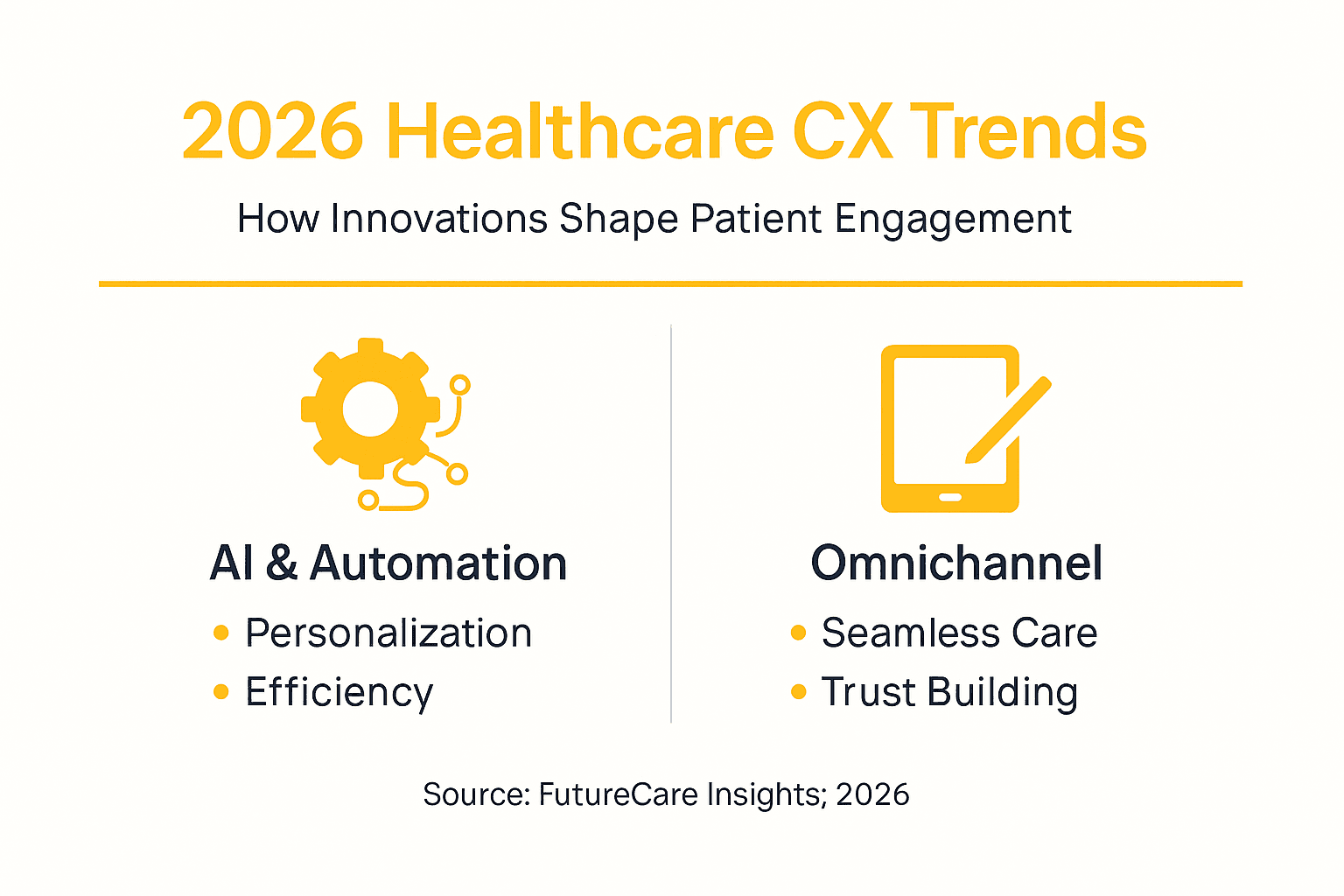
Start with AI-driven clinical decision support. AI supports clinical decision-making and patient management, freeing clinicians to focus on complex cases requiring human judgment. When AI handles routine assessments, your clinical team spends less time on documentation and more time on meaningful patient interactions.
Automation transforms administrative workflows. Scheduling, insurance verification, appointment reminders, and follow-up communications happen without manual intervention. Patients experience faster response times. Your staff handles higher volumes without burnout.
Data analytics reveals patterns humans miss. Population health programs use historical data to identify high-risk patients before readmissions occur. Predictive insights guide preventive outreach. You’re not reacting to problems—you’re preventing them.
Here’s how these three elements converge in practice:
- AI analyzes patient data to flag those at risk for no-shows or readmissions
- Automation triggers personalized outreach through the patient’s preferred channel
- Data feeds back into the system, continuously improving predictions and personalization
- Clinicians gain time to focus on complex care decisions that require empathy and judgment
The ethical dimension matters. Patient privacy, data security, and transparent AI decision-making build trust. Healthcare leaders must address these challenges head-on—compliance isn’t optional, and patients notice when organizations cut corners.
The organizations winning in 2026 don’t choose between technology and human care; they use technology to amplify human expertise.
Many CX directors worry that automation reduces the human touch. The opposite occurs when implemented correctly. Automation handles routine friction, allowing your team to engage in higher-value conversations that strengthen patient relationships and loyalty.
Pro tip: Audit your most time-consuming administrative tasks first. Identify repetitive processes like appointment confirmation or post-visit surveys, then pilot automation on those workflows before expanding to clinical decision support.
Omnichannel Strategies and Trust in Healthcare CX
Omnichannel isn’t about having every channel. It’s about making patients feel supported no matter which channel they choose. When a patient starts a conversation via SMS and switches to email, they shouldn’t repeat themselves. That seamless experience builds trust.
Healthcare organizations in 2026 recognize that omnichannel approaches ensure patients feel supported before, during, and after clinical encounters. Email, phone, SMS, web forms, and real-time feedback work as one unified system. Patients experience consistency across touchpoints.
Trust hinges on three factors:
- Data security and privacy compliance. Patients must believe their information is protected. Transparent policies about data handling build confidence.
- Seamless transitions across channels. Moving between email and phone without repeating information signals respect for patient time.
- Personalized communication respecting preferences. Some patients prefer SMS reminders; others want email. Respecting these choices demonstrates you listen.
Consistent communication matters most. Omnichannel strategies integrate email, phone, SMS, web forms, and real-time feedback to meet patient expectations for responsiveness and convenience. This isn’t just about contact centers—it extends to patient portals, billing, and clinical follow-up.
Hybrid cloud adoption enables this coordination. Cloud infrastructure lets your organization scale without losing data continuity. Partner with specialized CX providers who understand healthcare regulations and patient needs. They handle the operational complexity while your team focuses on strategic oversight.
Trust isn’t built through one perfect interaction—it’s built through consistent, reliable experiences across every channel, every time.
Conversational AI enhances this approach when paired with human empathy. AI handles routine inquiries quickly, but humans address emotional and complex needs. Patients feel heard, not processed.
Many healthcare leaders worry omnichannel requires rebuilding systems. Strategic partnerships and phased implementation reduce risk and cost. Start with your highest-volume channels, then expand systematically.
Pro tip: Map your patient journey across all channels and identify where transitions cause friction. Implement one seamless channel connection first, then expand based on what you learn.
Risks, Costs, and Mistakes in Modern CX Transformation
CX transformation sounds strategic until the bills arrive. Healthcare organizations often underestimate complexity, overestimate technology’s impact, and make costly decisions without adequate planning. Understanding these pitfalls helps you avoid them.
The biggest risk is overreliance on outdated metrics. Satisfaction scores tell you what patients thought yesterday, not whether they’ll return tomorrow. Modern CX transformation often focuses on front-end acquisition while neglecting post-purchase engagement, leaving loyal patients under-served while chasing new ones.
Integration costs spike fast. Systems don’t talk to each other. Data lives in silos. Compliance burdens add complexity. Security breaches expose vulnerabilities. One data incident costs reputation and revenue.
Common mistakes compound these risks:
- Inadequate speed in acting on feedback. Collecting patient feedback means nothing if response takes weeks.
- Failing to balance AI with human empathy. Technology handles volume, but patients need humans for trust.
- Neglecting employee experience. Burned-out staff deliver poor CX. Your team’s wellbeing directly impacts patient satisfaction.
- Poor omnichannel coordination. Fragmented channels frustrate patients and waste resources.
- Insufficient AI readiness. Deploying AI without proper infrastructure, training, and governance creates more problems than it solves.
Resource fatigue happens fast. Teams stretched thin implementing new systems can’t maintain what already exists. Healthcare organizations risk costly missteps by underestimating system integration complexity and ignoring employee experience. The result: disengaged patients and increased operational costs.
The most expensive mistake is starting transformation without a clear strategy connecting technology, processes, and people.
Why do these mistakes happen? Organizations chase shiny tools instead of solving real problems. They invest in front-end technology without building operational backbone. They measure short-term satisfaction instead of long-term loyalty.
Effective transformation requires alignment. Technology, processes, and workforce capabilities must work together. Start with a clear audit of current state, identify specific pain points, and invest strategically rather than comprehensively.
Pro tip: Before investing in new technology, map your highest-impact pain points and validate that technology solves them. Pilot with a small team, measure outcomes rigorously, then scale based on proven results.
Elevate Your Healthcare Customer Experience with Altiam CX
The article highlights the urgent need for disciplined execution in healthcare CX through building trust, reducing friction, and improving responsiveness. If you struggle with slow feedback response times, fragmented omnichannel communication, or balancing AI with the human touch, you are not alone. These pain points negatively impact patient loyalty and operational efficiency. Altiam CX specializes in addressing exactly these challenges by delivering scalable, culturally aligned customer care and back-office solutions designed to streamline patient engagement and improve service quality.

Experience how practicing strong operational discipline alongside advanced omnichannel strategies can transform patient outcomes and loyalty. Visit Altiam CX to explore our nearshore customer experience and operational services that empower healthcare providers. Learn how to reduce friction and boost responsiveness by integrating personalized communication and automation with human empathy. Start today to close the gap between collecting patient feedback and acting on it with reliable, measurable performance frameworks. Discover why healthcare leaders partner with Altiam by exploring our scalable team-extension solutions, and unlock the competitive advantage everyone is seeking in 2026.
Frequently Asked Questions
What are the key trends in customer experience (CX) for healthcare in 2026?
The key trends include a focus on trust over transactions, an omnichannel engagement strategy, and the importance of speedy response times to patient inquiries.
How does emotional impact influence patient outcomes in healthcare?
Emotional impact shapes patient outcomes by affecting how patients feel during their journey. Patients prioritize being heard, respected, and cared for, and these feelings are essential for building loyalty and achieving positive clinical results.
What innovations are shaping healthcare CX in 2026?
Innovations include AI-driven personalization, omnichannel communication platforms, cloud technology adoption, and proactive outreach automation, which enhance patient engagement, coordination of care, and overall satisfaction.
How can healthcare organizations measure long-term patient loyalty?
Organizations can measure long-term loyalty through indicators like repeat visits, referral rates, and whether patients recommend the provider to others, rather than just relying on traditional satisfaction metrics.
Recommended
- Why Customer Experience Matters in Healthcare CX
- 7 Customer Service Best Practices for Healthcare CX Leaders
- Healthcare Customer Experience Outsourcing: What Providers Expect in 2026
- Role of Customer Care Teams: Enhancing Healthcare and Ecommerce
- Role of Cybersecurity in Healthcare – Protecting Patient Trust