
Contact center QA is the continuous program that defines what “good” service looks like, measures interactions against observable scorecards, and turns those findings into coaching and operational change. The immediate action for any team starting or rebuilding a program: document observable standards and build a scorecard for your two or three most common interaction types before you touch software. AI and omnichannel coverage matter, but they only work once the standards underneath them are solid.
TL;DR:
- Regular calibration sessions and a precedent log are essential to ensure evaluators score interactions consistently and accurately.
- Mapping QA scorecard items to core business metrics like CSAT, NPS, and FCR helps ensure scores reflect actual customer outcomes and agent performance trends.
- AI-powered auto-evaluation can significantly increase review volume, but it should always be validated by human oversight, especially during initial implementation.
- Effective coaching relies on specific, evidence-based feedback focused on impactful issues, with clear follow-up targets to promote real performance improvement.
- For high-volume, regulated environments, investing in AI-driven QA platforms and managed service providers like Altiam CX can deliver faster, scalable results than manual processes alone.
Table of Contents
- What Contact Center QA Covers (and How It Differs From Quality Control)
- Building Scorecards That Hold Up Under Scrutiny
- Which Metrics Actually Connect to QA Scores
- Sampling vs. AI: How Much of Your Volume Should You Actually Review?
- From Scorecard to Coaching: Closing the Loop
- Compliance and Audit Trail Requirements
- What to Look for in a QA Platform
- A Practical Rollout Timeline
- How Altiam CX Operationalizes QA in Practice
- Manual Fixes or Platform Investment: A Decision Heuristic
- Managed QA Without the Build-It-Yourself Timeline
- Sources
- FAQ
What Contact Center QA Covers (and How It Differs From Quality Control)
Quality control is a snapshot. Someone flags a bad call, a supervisor reviews it, and the issue gets addressed in isolation. Contact center quality assurance is different: it’s an ongoing program that evaluates interactions systematically, over time, across every channel your team uses. Salesforce frames contact center QA as a discipline that ties evaluation directly to metrics and coaching, not a one-off audit.
That distinction shapes everything downstream. QC catches fires. QA prevents them by identifying patterns before they become customer complaints or compliance exposure.
A modern QA program has to cover every channel customers actually use, fulfilling key principles of omnichannel customer experience for growth:
- Voice calls, including IVR handoffs and hold behavior
- Live chat and asynchronous messaging
- Email correspondence
- Social media replies and direct messages
- SMS and text-based support
Ignoring any one of these creates a blind spot, and blind spots tend to show up exactly where customer trust is most fragile. A team that scores voice calls diligently but never reviews chat transcripts is running half a program. The goal of QA isn’t just catching errors. It’s driving three outcomes at once: better customer experience, documented compliance, and targeted coaching that actually improves agent performance instead of just labeling it.
Building Scorecards That Hold Up Under Scrutiny
A scorecard is only useful if two different evaluators reach the same score on the same interaction. That sounds obvious, but it’s where most programs break down.
Here’s the anatomy of a scorecard that works:
- Weighted categories that reflect what actually matters to the business (compliance, resolution, tone, process adherence) rather than equal weighting across everything
- Observable yes/no checks for binary behaviors: Did the agent verify identity? Did they state the required disclosure?
- Scaled behavioral items for judgment calls, like tone or empathy, scored on a consistent 1 to 5 rubric with written anchors for each point
- Auto-fail logic that zeroes out a score regardless of other points when a compliance item is missed
Voxjar’s guidance recommends keeping scorecards to 25 criteria or fewer. Beyond that, evaluators start rushing through items or interpreting them inconsistently, which defeats the purpose of standardization. Every item should be phrased as a question an evaluator can answer by observing the interaction, not by guessing at intent.
Calibration is what keeps the whole system honest. Run calibration sessions on a fixed cadence (weekly during rollout, biweekly once stable) where multiple evaluators score the same recorded interaction independently, then compare notes. Document the precedents that come out of disagreements so the next evaluator doesn’t have to relitigate the same question.

Pro Tip: Keep a running “precedent log” from calibration sessions. When two evaluators disagree on how to score an ambiguous interaction, write down the resolution and date it. Six months in, that log becomes your most valuable training document for new evaluators.
Which Metrics Actually Connect to QA Scores
QA scores mean nothing if they float disconnected from the metrics leadership actually watches. The job is to map specific scorecard items to specific outcomes.
The core metrics every program should track:
- CSAT (customer satisfaction): tied most directly to tone, empathy, and how an agent handles friction
- NPS (net promoter score): reflects the cumulative effect of service quality over time, not one interaction
- FCR (first contact resolution): maps directly to scorecard items about escalation judgment and troubleshooting depth
- AHT (average handle time): needs to be read alongside quality, never in isolation, or agents start rushing calls to hit a number
- CES (customer effort score): captures how much work the customer had to do to get their issue solved
- Service level: the operational metric measuring speed of response against a target, often expressed as the 80/20 standard
A concrete example: if an agent’s scorecard shows repeated deductions for skipping the escalation-path questions, that pattern will show up in falling FCR before it ever shows up in a customer complaint. Effective QA measures both sides of that equation, the customer outcome and the agent development trend, because a score with no trend line attached is just a number.
Program health itself needs its own metrics: are scores trending up or down over quarters, and do they actually correlate with CSAT movement? If your QA scores are climbing while CSAT stays flat, your scorecard is measuring the wrong things. For a deeper look at how to structure this, see how CX ops teams use CSAT and NPS together to make operational decisions.
Sampling vs. AI: How Much of Your Volume Should You Actually Review?
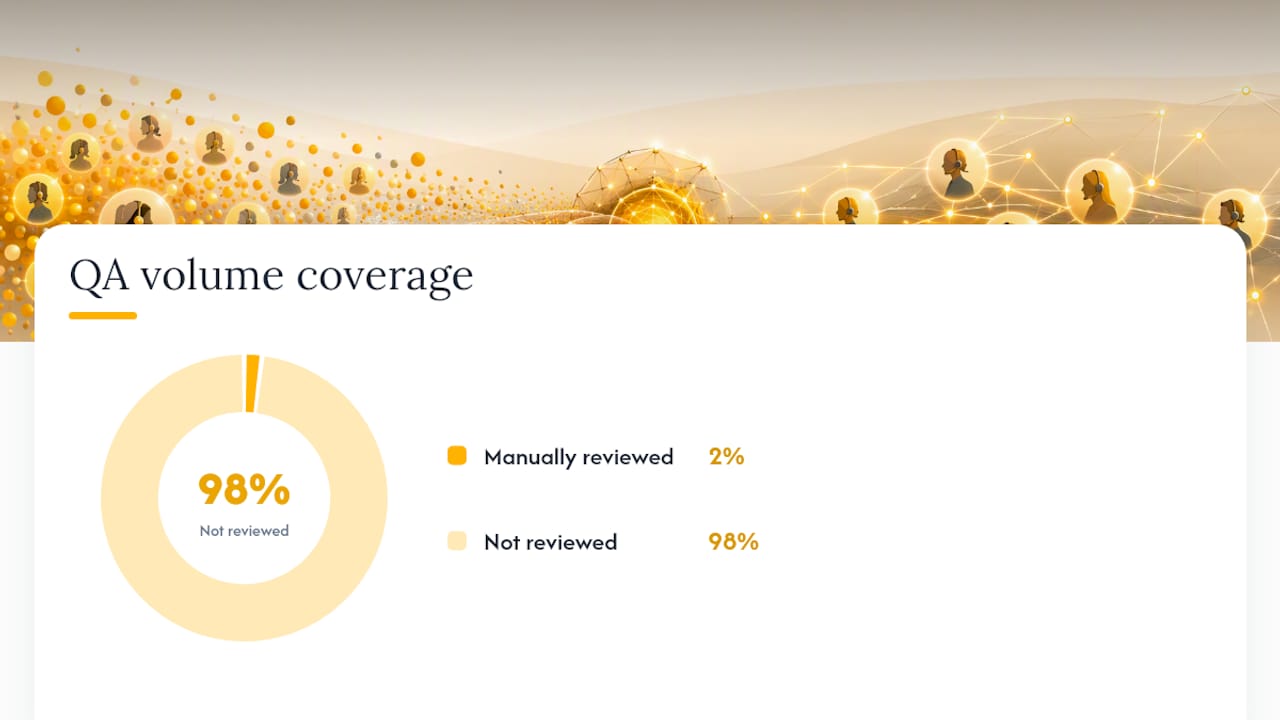
Manual QA has always run into a hard math problem. A single reviewer can realistically evaluate 20 to 30 calls a day. Scale that against a center handling thousands of daily interactions, and traditional programs land at reviewing only a small share of total volume.
That’s not a design choice. It’s a constraint born from headcount, and it means the vast majority of interactions never get looked at by anyone.
AI-powered auto-evaluation changes that math directly. Verint’s analysis points to programs moving from single-digit sampling to evaluating close to the full volume of interactions, with automated scoring flagging patterns humans would never catch at a 2% sample size. Zoom’s product documentation on auto-QM describes systems that generate not just a score but a justification: the specific moment in a transcript, the sentiment shift, the topic that triggered the flag.
That said, auto-scoring without human validation is its own risk. Treat AI output as a first pass, not a verdict.
A pragmatic rollout looks like this:
- Start with a voice-only pilot on one queue or interaction type
- Run AI scoring in parallel with human evaluators for at least a month to check agreement rates
- Expand to chat and email once voice accuracy is validated
- Define governance rules for when a human must override an auto-score
Our guide on selecting and piloting AI tools for customer support walks through the vendor evaluation questions that matter most at this stage.
From Scorecard to Coaching: Closing the Loop
The most common failure in QA programs isn’t bad scoring. It’s accurate scores that nobody acts on. A scorecard sitting in a spreadsheet doesn’t change agent behavior. Coaching does, but only if it’s targeted correctly.
Here’s the sequence that actually moves performance:
- Prioritize by impact, not by lowest score. An agent with an 85% average who consistently fails the same compliance item needs a different conversation than an agent with an 80% average and scattered, minor misses.
- Cite specific evidence in every coaching session. Pull the transcript moment, play the clip, point to the exact scorecard item. Vague feedback (“be more empathetic”) doesn’t change behavior; specific feedback (“here’s where you cut the customer off at 2:14”) does.
- Set a measurable follow-up. Every coaching conversation should end with a concrete target to check in the next evaluation cycle, not a general reminder to “do better.”
Real-time coaching adds another layer: event-based triggers that flag a struggling interaction while it’s still happening, so a supervisor can intervene before it becomes a bad survey response.
Pro Tip: Feed QA data into scheduling and learning systems, not just performance reviews. If a specific mistake keeps recurring across a shift, that’s often a training gap, not an individual coaching issue.
Our piece on evidence-based service quality strategies goes deeper into structuring these conversations for measurable change.
Compliance and Audit Trail Requirements
Regulated interactions, healthcare, financial services, legal intake, need QA to double as an evidence system. Every score should carry a timestamp, a transcript or recording reference, and a documented remediation step if something failed.
Build compliance checks as hard auto-fail gates, separate from behavioral scoring:
- Mandatory disclosure language stated verbatim or not at all
- Identity verification completed before account details are discussed
- Data-handling steps followed for any interaction touching sensitive information
- Recording consent captured where required by law
Call recording rules vary significantly by state, and getting this wrong carries real financial exposure. Our breakdown of call recording laws across different jurisdictions is worth reviewing before you finalize scorecard language. Set a review cadence, monthly at minimum for regulated queues, so audit readiness never becomes a scramble.
What to Look for in a QA Platform
Skip the feature-by-feature vendor pitch and evaluate platforms against a functional checklist instead. The capabilities that actually matter:
- Omnichannel ingestion that pulls voice, chat, email, and social into one evaluation queue
- Accurate transcription, since a bad transcript poisons every downstream score
- Sentiment and intent detection layered on top of raw transcription
- Configurable scorecards that support different forms per client or department
- Evidence-backed auto-scores with a visible explanation, not a black-box number
- Reporting that surfaces trends, not just individual interaction scores
- Integration with your LMS, CRM, and workforce management systems
Operationally, the platform should surface coaching prompts to supervisors in the flow of their existing workflow, not in a separate tool they have to remember to check. For multi-client operations, per-client scorecards with defensible, attached evidence matter more than a single one-size-fits-all form.
A Practical Rollout Timeline
Most programs stall because they try to do everything at once. A phased approach works better:
- Week 0: Align stakeholders on objectives and pick the two or three interaction types generating the most volume or risk.
- Month 1 to 2: Build scorecards for those interaction types, run a pilot combining manual sampling with limited AI scoring, and start weekly calibration sessions.
- Month 3 to 6: Expand coverage to additional channels, increase coaching cadence based on early findings, and measure whether QA score trends correlate with CSAT and FCR movement.
Our manager’s guide to measuring service quality breaks this timeline down further with sample templates for each phase.
How Altiam CX Operationalizes QA in Practice
Altiam CX supports customer care, technical assistance, back-office operations, and managed team extension for organizations that need this framework running without building it from scratch internally. In one implementation, optimized customer care workflows cut handling time by roughly 30%, a direct result of scorecard-driven coaching tied to specific escalation and resolution behaviors.
Bilingual agent deployment has produced measurable movement on NPS alongside reduced handle time, reinforcing that QA outcomes and staffing strategy are connected, not separate initiatives. These results reflect what disciplined scorecard design plus consistent calibration can produce at scale.
Manual Fixes or Platform Investment: A Decision Heuristic
High volume, heavy compliance exposure, or rising churn all point toward AI-driven QA. If your center handles under a few hundred interactions a day with low regulatory risk, better calibration and coaching discipline will likely outperform a platform investment. Run a pilot only once your scorecards are stable enough that a machine has something reliable to learn from.
— Daniela
Managed QA Without the Build-It-Yourself Timeline
Altiam CX is the alternative to building a QA function from scratch when your team needs results faster than an internal hiring and tooling cycle allows. Instead of assembling evaluators, calibration processes, and platform integrations one piece at a time, you get a managed operation that already runs scorecards, coaching loops, and bilingual agent coverage as a single system.

This is where the roadmap above turns from a planning document into an active program. Whether you’re piloting AI-assisted scoring on a single queue or scaling coverage across every channel your customers use, Altiam CX plugs in at the pilot, scale, or full managed-operations stage depending on where your team currently stands. One case study on tech support migration shows a productivity improvement of 89% after moving support operations into a managed nearshore structure. If you’re weighing whether to build internally or bring in a partner to run the program, that case study is a reasonable place to see what a completed implementation actually looks like.
Sources
For deeper detail on the frameworks referenced here, consult Salesforce’s QA definition, Verint’s best-practices guide, Voxjar’s scorecard guide, and Talkdesk’s comprehensive overview.
- Contact Center Quality Assurance: Definition and Tactics | Salesforce
- Call Center Quality Assurance Best Practices Guide | Verint
- QA for Call Centers: The Complete Guide | Voxjar
- Contact center quality assurance | Zoom blog
FAQ
What Does a QA Analyst Do in a Call Center?
A QA analyst reviews recorded or live interactions against a scorecard, scores agent performance against observable standards, and feeds findings into coaching and process improvement. They also participate in calibration sessions to keep scoring consistent across the team.
How Do You Improve QA in a Call Center?
Start by tightening scorecard design to observable, specific criteria capped around 25 items, then run regular calibration sessions to reduce inter-rater variance. Expanding coverage with AI-assisted scoring and connecting scores directly to coaching cycles closes the gap between “known issue” and “fixed issue.”
Is Working in Contact Center QA a Difficult Job?
It demands sustained attention to detail and comfort giving specific, sometimes uncomfortable feedback backed by transcript evidence. The difficulty usually comes less from the evaluation itself and more from keeping scoring consistent across dozens of interactions a day without evaluator fatigue setting in.
What Is the Best Contact Center QA Software?
The right choice depends on your channel mix, compliance requirements, and whether you need per-client scorecards for multi-account operations. Look for platforms offering omnichannel ingestion, evidence-backed auto-scores, and integration with your existing LMS and CRM rather than choosing based on brand recognition alone; managed providers like Altiam CX can also run the full program for teams that prefer not to build and maintain the platform internally.