
Companies that outsource back-office operations unlock up to 40% cost savings while boosting customer satisfaction by 25%. Yet many executives hesitate, fearing loss of control or hidden expenses. This guide cuts through the noise, explaining what back-office outsourcing delivers in 2026, how nearshore and offshore models compare, and which strategies maximize value. You’ll learn industry-specific applications, proven frameworks for vendor management, and how to turn back-office efficiency into a competitive edge.
Table of Contents
- What Are Back-Office Tasks And Why They Matter
- Core Reasons Why Businesses Outsource Back-Office Functions
- Nearshore Vs Offshore Outsourcing: What Business Leaders Need To Know
- Common Misconceptions About Outsourcing Back-Office Tasks
- Impact Of Back-Office Outsourcing On Customer Experience
- Industry-Specific Cases: Healthcare, Legal, And Ecommerce
- Managing Outsourcing Relationships: Performance Metrics And Risk Mitigation
- Maximizing Value From Back-Office Outsourcing
- Explore Nearshore Back-Office Outsourcing Solutions With Altiam CX
Key takeaways
| Point | Details |
|---|---|
| Cost reduction | Outsourcing cuts operational expenses by 25-40% through labor arbitrage and process optimization. |
| Nearshore advantage | Closer time zones and cultural fit improve communication and reduce risk compared to offshore. |
| Customer experience boost | Faster processing and specialized expertise drive 15-25% gains in satisfaction scores. |
| Myth-busting | Strong governance frameworks and transparent contracts eliminate control and hidden cost concerns. |
| Success metrics | Clear KPIs, SLAs, and continuous monitoring ensure quality and sustained performance. |
What are back-office tasks and why they matter
Back-office tasks are the internal operations that keep your business running smoothly but remain invisible to customers. These include billing, claims processing, data entry, document management, inventory reconciliation, and payroll. Unlike front-office functions that interact directly with clients, back-office work supports core activities from behind the scenes.
In healthcare, billing and claims processing ensure revenue cycles stay on track. Legal firms depend on document review and client intake coordination to serve cases efficiently. eCommerce companies rely on inventory management and order fulfillment to meet delivery promises. When these tasks break down, customer experience suffers immediately.
Common back-office tasks by industry:
- Healthcare: medical billing, claims adjudication, patient records management
- Legal: contract review, case file preparation, client intake scheduling
- eCommerce: order processing, returns management, supplier coordination
- All sectors: payroll administration, accounts payable, HR onboarding
Back-office efficiency directly impacts your bottom line and customer perception. Slow claims processing frustrates patients. Delayed order fulfillment drives shoppers to competitors. Accurate, timely back-office work creates capacity for strategic growth while preventing costly service failures.
Core reasons why businesses outsource back-office functions
Outsourcing back-office tasks reduces costs by 25-40% through labor arbitrage and streamlined processes. You gain immediate access to specialized talent without recruiting overhead or training delays. Providers invest in automation and best practices that would take years to build internally.
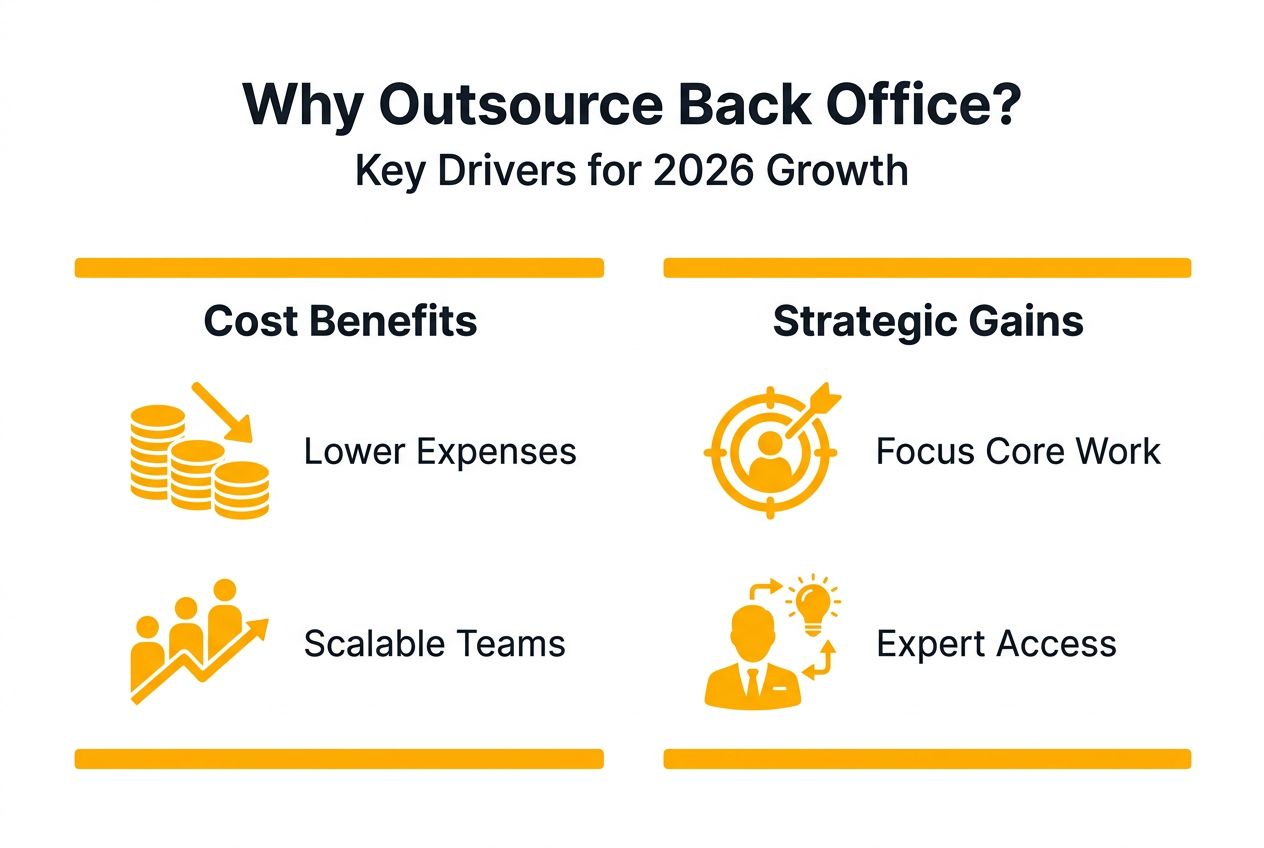
Operational efficiency improves when experts handle repetitive tasks at scale. Your internal teams focus on strategic priorities instead of administrative burdens. Outsourcing partners deliver consistent quality through standardized workflows and dedicated quality assurance programs.
Scalability becomes effortless. Seasonal demand spikes or rapid business expansion no longer require lengthy hiring cycles. Outsourcing lets you scale capacity up or down within weeks, matching resources precisely to workload.
Primary drivers for outsourcing:
- Cost savings from lower labor rates in nearshore or offshore locations
- Access to specialized skills in compliance, technology, or industry-specific processes
- Enhanced focus on core business activities by offloading administrative work
- Faster speed to market through immediate resource availability
Pro Tip: Identify tasks consuming significant internal hours but requiring minimal strategic input. These high-volume, low-complexity functions deliver the fastest outsourcing ROI.
Businesses exploring back-office outsourcing for efficiency often discover hidden capacity gains. When you redirect internal talent toward revenue-generating activities, productivity compounds across the organization. Nearshore BPO partnerships offer additional advantages through cultural alignment and time zone compatibility.
Nearshore vs offshore outsourcing: what business leaders need to know
Nearshore outsourcing places operations in neighboring countries with similar time zones and cultural norms. Offshore models move work to distant regions like Asia or Eastern Europe. Both reduce costs, but nearshoring offers distinct operational advantages.
Cultural and language compatibility matters more than most executives realize. Nearshore teams communicate naturally in real time, avoiding the translation delays and misunderstandings common in offshore arrangements. Shared business practices and work styles reduce friction during collaboration.
Time zone proximity transforms daily operations. Overlapping work hours enable live problem-solving, faster decision cycles, and immediate escalation when issues arise. Offshore partnerships often require asynchronous handoffs that slow response times and complicate urgent requests.
| Factor | Nearshore | Offshore |
|---|---|---|
| Time zones | 0-3 hour difference | 8-12 hour difference |
| Cultural alignment | High similarity | Moderate to low |
| Communication ease | Real-time collaboration | Asynchronous handoffs |
| Cost savings | 30-50% reduction | 50-70% reduction |
| Risk profile | Lower governance complexity | Higher coordination overhead |
Key considerations when choosing location strategy:
- Evaluate whether real-time communication justifies slightly higher nearshore rates
- Consider regulatory compliance requirements that favor regional proximity
- Assess your team’s capacity to manage asynchronous workflows for offshore models
- Factor in travel costs and time for periodic on-site visits
Pro Tip: Start with nearshore partnerships for customer-facing or complex processes requiring frequent collaboration, then consider offshore for isolated, highly standardized tasks.
Understanding what nearshore outsourcing delivers helps you match location strategy to business priorities. Many organizations combine both approaches, using nearshore CX and team extensions for strategic functions while offshoring transactional work.
Common misconceptions about outsourcing back-office tasks
Many executives fear losing control when transferring operations to external partners. In reality, transparent contracts and performance dashboards often provide better visibility than internal processes. You define service levels, monitoring frequency, and escalation protocols upfront, creating accountability frameworks rarely present in-house.
The hidden cost myth persists despite evidence to the contrary. Transparent cost structures reduce overruns by 60% when contracts specify pricing models, scope boundaries, and change management procedures. Fixed-fee arrangements eliminate budget surprises common in time-and-materials deals.
Quality degradation concerns ignore the specialization advantage outsourcing providers bring. Dedicated teams handling specific tasks daily develop expertise and efficiency that generalist internal staff cannot match. Providers implement quality controls and audits to protect their reputation and contract renewals.
Debunking common outsourcing myths:
- Myth: You lose process control and visibility
- Reality: Governance frameworks and real-time reporting enhance oversight
- Myth: Hidden fees inflate total costs unpredictably
- Reality: Well-structured contracts with clear scope prevent budget creep
- Myth: Quality suffers without direct management
- Reality: Specialized providers maintain higher standards through focus and accountability
“The best outsourcing relationships operate with greater transparency than many internal departments. When KPIs and reporting cadences are contractually mandated, executives gain clearer insight into performance and costs.”
Fears about vendor dependency can be managed through multi-sourcing strategies and knowledge transfer requirements. Building redundancy into your outsourcing model protects against single points of failure while maintaining flexibility to switch providers if performance declines.
Impact of back-office outsourcing on customer experience
Customers never see your back office, but they feel its performance instantly. When outsourcing drives processing improvements of 15-25%, customer satisfaction scores climb proportionally. Faster claims approvals, accurate billing, and timely order fulfillment eliminate friction points that erode loyalty.

Specialized expertise reduces costly errors that damage trust. Medical billing specialists catch coding mistakes before claims get rejected. Legal process experts ensure documents meet court requirements the first time. eCommerce fulfillment teams prevent shipping errors that trigger returns and complaints.
Data-driven improvements become standard when outsourcing partners track performance metrics continuously. You gain insights into bottlenecks, error patterns, and efficiency opportunities that were invisible before. Regular reporting creates accountability and enables rapid course corrections.
Customer experience benefits from back-office outsourcing:
- Reduced wait times for approvals, refunds, and issue resolution
- Fewer billing errors and payment processing problems
- Faster order fulfillment and delivery accuracy
- Improved first-contact resolution through better information management
- Consistent service quality across all customer touchpoints
The compound effect matters most. When every back-office process runs smoothly, customers experience your brand as reliable and professional. Small improvements across multiple touchpoints create differentiation competitors struggle to match.
Industry-specific cases: healthcare, legal, and eCommerce
Healthcare organizations outsource medical billing and claims processing to navigate complex coding requirements and payer rules. Specialized vendors achieve 98% clean claim rates compared to 85-90% for in-house teams. This accuracy speeds reimbursement cycles and reduces revenue leakage from denied claims.
Legal service providers outsource document review, contract analysis, and client intake coordination. Law firms cut document processing time by 40% while ensuring consistent quality across high-volume matters. Paralegals focus on strategic case support instead of administrative tasks.
eCommerce companies delegate order fulfillment, inventory reconciliation, and returns processing to scale rapidly without warehouse expansion. Outsourcing partners handle seasonal volume spikes that would require permanent staff increases. Technology integration enables real-time inventory visibility across multiple fulfillment centers.
| Industry | Outsourced Function | Typical Improvement |
|---|---|---|
| Healthcare | Medical billing | 30% faster reimbursement |
| Healthcare | Claims processing | 98% clean claim rate |
| Legal | Document review | 40% time reduction |
| Legal | Client intake | 50% faster onboarding |
| eCommerce | Order fulfillment | 35% cost savings |
| eCommerce | Returns processing | 60% faster resolution |
Industry-specific outsourcing applications:
- Healthcare: patient scheduling, insurance verification, medical transcription
- Legal: case file preparation, litigation support, compliance monitoring
- eCommerce: customer service, product data management, supplier coordination
CX outsourcing strategies vary by industry but share common success factors. Understanding why business process outsourcing works across sectors helps you identify opportunities in your operations. Healthcare customer experience outsourcing continues evolving as regulatory requirements and patient expectations increase.
Managing outsourcing relationships: performance metrics and risk mitigation
Successful outsourcing starts with clearly defined KPIs and SLAs written into contracts before work begins. Specify turnaround times, accuracy thresholds, customer satisfaction targets, and response requirements for different issue severities. Vague expectations guarantee disappointment.
Contract and vendor management controls hidden costs and prevents dependency. Include price escalation limits, scope change procedures, and performance penalties for missed SLAs. Require regular cost reporting and benchmark reviews to maintain competitive pricing.
Risk mitigation strategies protect against vendor failure or performance degradation. Phase implementations to test capabilities before full transition. Maintain documentation of processes and workflows so you can bring work back in-house or switch providers if needed. Consider splitting high-volume processes across multiple vendors to avoid single points of failure.
Continuous performance monitoring catches problems before they impact customers. Weekly scorecards track KPIs and trigger escalation when metrics slip. Monthly business reviews examine trends, discuss improvement opportunities, and align on strategic priorities.
Governance framework essentials:
- Establish baseline metrics before outsourcing to measure improvement accurately
- Define escalation paths and response time requirements for different issue types
- Schedule regular audits of processes, quality controls, and security practices
- Create joint improvement roadmaps that align vendor incentives with your goals
- Implement change control processes that prevent scope creep and cost overruns
Recommended monitoring cadence:
- Daily: real-time dashboards tracking volume, turnaround time, and error rates
- Weekly: scorecard reviews and performance trend analysis
- Monthly: business reviews covering strategic alignment and improvement initiatives
- Quarterly: comprehensive audits and contract compliance assessments
Pro Tip: Build performance incentives into contracts that reward exceeding targets, not just meeting minimums. Shared success metrics align vendor motivation with your business outcomes.
Relationship optimization requires treating outsourcing partners as extensions of your team. Share business context, involve them in planning discussions, and recognize exceptional performance. The best partnerships evolve from transactional service delivery to strategic collaboration.
Maximizing value from back-office outsourcing
Back-office outsourcing delivers measurable benefits when you match the right tasks to capable partners and manage relationships actively. Cost reductions of 25-40%, efficiency gains of 15-25%, and improved customer satisfaction create competitive advantages that compound over time.
Decision checklist for outsourcing success:
- Identify high-volume, standardized tasks consuming significant internal resources
- Evaluate whether nearshore cultural alignment justifies premium over offshore rates
- Define clear KPIs, SLAs, and governance frameworks before selecting vendors
- Phase implementations to validate capabilities and build confidence gradually
- Establish continuous monitoring and regular business reviews from day one
Stepwise adoption approach:
- Pilot with non-critical processes to test vendor capabilities and refine governance
- Expand to core functions once performance metrics consistently meet targets
- Optimize through data analysis, process improvements, and strategic collaboration
- Scale by adding complexity or volume as partnership maturity increases
Outsourcing transforms back-office operations from cost centers into strategic enablers. You redirect internal talent toward innovation and growth while specialized partners handle administrative burdens efficiently. The key lies in rigorous vendor selection, clear expectations, and active relationship management that treats outsourcing as a partnership rather than a transaction.
Explore nearshore back-office outsourcing solutions with Altiam CX
When you’re ready to implement the outsourcing strategies covered here, nearshore customer experience partnerships offer the cultural alignment and operational control executives value most.

Altiam CX specializes in back-office operations for healthcare, legal, and eCommerce organizations seeking scalable solutions without sacrificing quality. Our managed team extension services combine specialized expertise with measurable performance frameworks that reduce costs while improving service delivery. Explore how our legal services capabilities have helped firms streamline operations and focus on growth.
FAQ
What back-office tasks are best suited for outsourcing?
High-volume, repetitive processes with clear procedures deliver the fastest ROI. Billing, data entry, claims management, and document processing work well because they follow standardized workflows. Tasks requiring minimal strategic input but consuming significant internal hours make ideal candidates.
How can businesses ensure quality control when outsourcing back-office tasks?
Implement detailed KPIs and SLAs that specify accuracy thresholds, turnaround times, and escalation procedures. Schedule regular audits of work samples and require real-time performance dashboards. Performance-based contracts with financial penalties for missed targets maintain accountability.
What are the main differences between nearshore and offshore outsourcing?
Nearshore providers operate in similar time zones and share cultural norms, enabling real-time collaboration and reducing communication friction. Offshore models offer deeper cost savings but require asynchronous workflows and more complex coordination. Choose nearshore for customer-facing or complex processes needing frequent interaction.
How does outsourcing back-office tasks improve customer experience?
Specialized teams process transactions faster and more accurately than generalist internal staff, reducing wait times and errors. When claims get approved quickly, orders ship on time, and billing runs smoothly, customers perceive your brand as reliable and professional. These operational improvements translate directly to higher satisfaction scores.