

TL;DR:
- Improving service quality requires structured frameworks like TQM, SERVQUAL, and DMAIC.
- Service quality enhancements lead to reduced costs, higher client retention, and increased revenue across sectors.
- Sustaining gains demands leadership focus on culture, empathy, and integrating technology with human touch.
Adequate service quality is not the same as excellent service quality, and the gap between the two carries a price most executives haven’t fully calculated. Legal firms alone lose $250,000 on average from missed service calls annually. Healthcare systems face safety risks and rising costs when patient experience lags. E-commerce brands bleed retention when their service models fail to scale. The real question is not whether improving service quality matters. It is how much longer organizations can afford to treat it as a secondary priority. This guide breaks down the frameworks, sector-specific outcomes, and executive strategies that make service quality a direct driver of growth.
Table of Contents
- What does improving service quality really mean?
- Sector-by-sector impact: Healthcare, legal, and e-commerce
- Strategic benefits: Why executives must prioritize service quality
- Advanced insights: Overcoming challenges and sustaining gains
- Our take: What most leaders miss about service quality
- Turn service quality into results with Altiam CX
- Frequently asked questions
Key Takeaways
| Point | Details |
|---|---|
| Frameworks matter | Proven methodologies like SERVQUAL, TQM, and Lean Six Sigma drive real improvements in outcomes and efficiency. |
| Sector success factors | Impact varies across healthcare, legal, and e-commerce, but all can achieve measurable gains with tailored approaches. |
| Strategic alignment | Linking service quality efforts to executive KPIs and bottom-line goals ensures lasting impact. |
| Human touch challenge | Sustaining empathy and personalization remains the toughest and most rewarding executive focus area. |
What does improving service quality really mean?
Many executives assume service quality improvement is simply about training front-line staff or adding a feedback survey. It is far more structured than that. Three proven frameworks define how serious organizations approach this work.
Total Quality Management (TQM) is a company-wide philosophy that aligns every department around continuous improvement and customer focus. It is not a one-time project. TQM reshapes how processes, people, and goals connect across an organization. Studies confirm that TQM significantly enhances operational efficiency and satisfaction, particularly in healthcare settings.
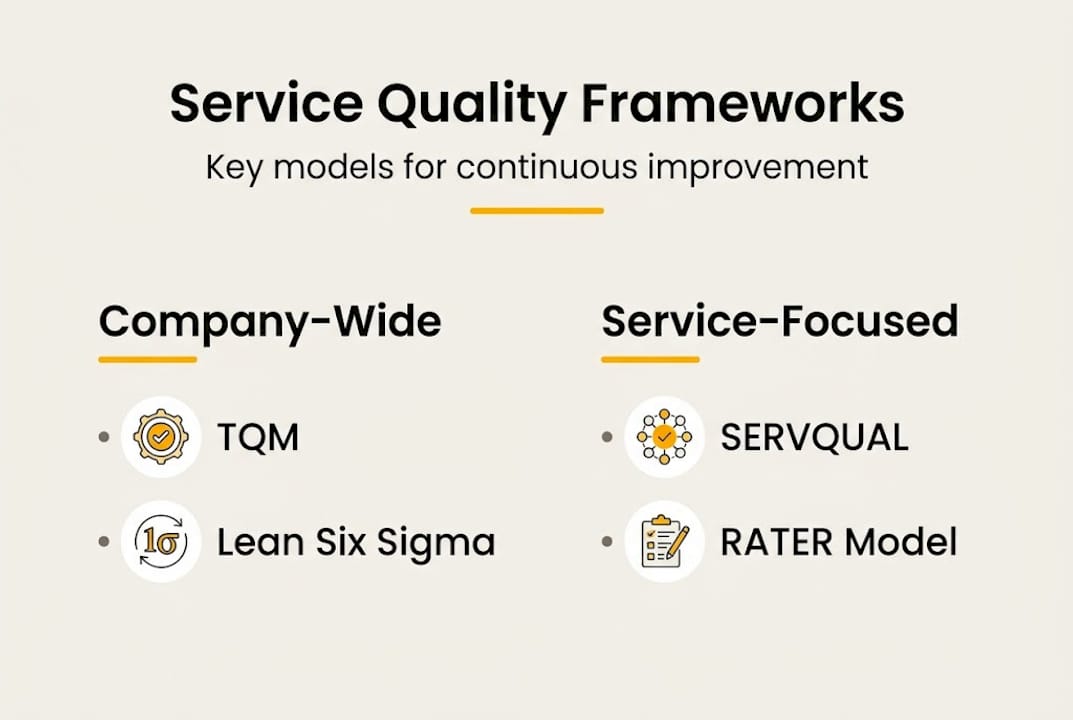
SERVQUAL, built on the RATER model, measures service quality across five dimensions: Reliability, Assurance, Tangibles, Empathy, and Responsiveness. It is diagnostic. SERVQUAL helps executives identify exactly where the gap exists between what customers expect and what they actually receive.
Lean Six Sigma DMAIC (Define, Measure, Analyze, Improve, Control) is a data-driven process improvement cycle. When applied correctly, DMAIC reduces cycle time by 37.5% and errors by 80%. That is not incremental. That is structural transformation.
For a broader view of how these fit within the wider landscape of process improvement methodologies, it helps to see how each one targets a different layer of operational failure.
| Framework | Primary Focus | Key Strength | Measurable Impact |
|---|---|---|---|
| TQM | Culture and systems | Company-wide alignment | Satisfaction and efficiency |
| SERVQUAL (RATER) | Customer perception gaps | Diagnostic precision | Gap closure and loyalty |
| Lean Six Sigma DMAIC | Process and error reduction | Data-driven control | Cycle time and defect reduction |
A common mistake leaders make is treating these as competing options. They are complementary. SERVQUAL tells you where the problem is. DMAIC tells you how to fix it. TQM ensures the fix sticks.
Pro Tip: Choose your methodology based on the nature of the problem, not its popularity. If your challenge is measurement, start with SERVQUAL. If you need process repair, run DMAIC. If cultural drift is the root cause, TQM is your foundation.
Before selecting any framework, ask yourself:
- Where are our service gaps showing up most frequently (response time, accuracy, empathy)?
- Are we measuring customer experience from the customer’s perspective or our internal metrics?
- Do our quality improvement efforts have executive sponsorship or are they delegated downstream?
- Are service failures tracked, analyzed, and fed back into process design?
For organizations seeking customer care improvement tips that translate these frameworks into daily operations, the strategic starting point is always the same: honest diagnosis before action.
Sector-by-sector impact: Healthcare, legal, and e-commerce
Frameworks only matter when they produce results. Here is what improving service quality actually delivers across three of the most demanding sectors.
Healthcare carries the highest stakes. Patient safety, regulatory exposure, and reimbursement rates all connect directly to service quality. Research confirms that improving healthcare quality reduces errors, lowers costs, and raises patient satisfaction simultaneously. When these improvements are coordinated through a quality framework, organizations stop treating symptoms and start fixing systems. Executives focused on healthcare customer care strategies that tie clinical outcomes to patient experience will find the ROI both measurable and compelling.

Legal is where service responsiveness becomes a revenue variable. Research shows that 21x higher lead conversion is achievable when firms respond within five minutes. Yet 35% of calls go unanswered, costing each firm $250,000 on average. Intake process failures, slow follow-ups, and inconsistent communication are service quality failures, not just operational inconveniences. The role of customer care in legal settings is now a competitive differentiator that directly impacts client acquisition.
E-commerce is being reshaped by AI-powered hybrid service models. Data shows that AI-hybrid models increase conversion by 1.1%, boost retention to 28.5%, and improve profitability by 6.3%. These are not incremental gains. They represent a meaningful shift in how service quality is engineered at scale.
| Sector | Key Metric Improved | Financial Impact |
|---|---|---|
| Healthcare | Error reduction, patient satisfaction | Lower costs, better reimbursement |
| Legal | Lead conversion, responsiveness | Up to $250k revenue protected |
| E-commerce | Retention, conversion, profitability | 6.3% profitability increase |
Three success factors executives must target in each sector:
- Healthcare: Tie quality metrics to patient empathy outcomes, not just clinical scores.
- Legal: Build a 24/7 intake process that eliminates missed contact opportunities.
- E-commerce: Combine AI-driven personalization with human escalation paths to protect loyalty.
“Service responsiveness is not a soft skill. It is a financial asset. In legal markets, the firm that responds first wins the client most of the time.”
Strategic benefits: Why executives must prioritize service quality
The sector-level outcomes point to something larger. Service quality improvement is not a department-level initiative. It is a strategic lever that touches revenue, brand equity, and long-term client value.
When organizations close service gaps systematically, they generate compounding returns. Higher satisfaction drives stronger retention. Retained clients generate more referrals. Referrals lower customer acquisition costs. And clients who receive consistently excellent service are far more likely to expand their relationship with your organization. This is the lifetime value loop that most quality initiatives fail to fully activate.
The data supports this directly. Research using a combined SERVQUAL, AHP, and Six Sigma model shows that service quality gap closure explains up to 92% of improved customer outcomes (R²=0.92). That is a statistically strong relationship between quality investment and measurable results.
Strategic wins executives gain from disciplined service quality improvement:
- Cost avoidance: Reducing service failures cuts the cost of rework, escalations, and churn-related recovery campaigns.
- Brand loyalty: Consistent service quality becomes a brand signal that competitors cannot easily replicate.
- Regulatory compliance: In healthcare and legal sectors, quality frameworks help organizations stay ahead of regulatory requirements proactively.
- Competitive positioning: Organizations that lead on service quality in their sector tend to win and retain premium clients disproportionately.
Pro Tip: Move away from process-only KPIs. Tie performance indicators to actual outcomes such as client retention rates, net promoter scores, and resolution rates. These tell you whether quality improvements are landing where it matters. For a structured approach, review proven steps for service quality that connect metrics to results at the executive level.
The strategic case is clear. Organizations that treat service quality as a core business function, not a support function, build the operational resilience needed to scale without sacrificing the client experience that drove their initial growth.
Advanced insights: Overcoming challenges and sustaining gains
Most service quality initiatives show results in the first 90 days. The harder challenge is sustaining them at the 18-month mark, especially when leadership priorities shift or operational pressure increases.
Research highlights that cultural diversity, after-hours demands, and empathy represent the most persistent real-world hurdles for organizations trying to sustain quality gains. These are not problems that a process update solves. They require leadership attention and organizational design.
Common pitfalls that undermine sustained service quality:
- Ignoring cultural differences in multilingual or multinational service environments, which leads to tone mismatches and unresolved friction.
- Neglecting after-hours service demand, which creates gaps that erode trust even when daytime performance is strong.
- Over-focusing on quantitative metrics while allowing empathy and human connection to quietly decline.
- Treating re-training as the solution to every quality failure, when the root cause is often a structural or incentive misalignment.
There is also a sobering pattern in healthcare specifically. Data shows that declines in empathy occur alongside clinical quality gains, suggesting that over-indexing on measurable indicators can hollow out the human experience that patients and clients actually value most.
“Maintaining gains is harder than achieving them. The organizations that sustain service quality improvements are the ones where executives model customer-first behavior, not just monitor it.”
AI and automation add another layer of complexity. In e-commerce and high-volume service environments, scaling with technology is necessary. But efficiency gains erode client trust when the human escalation path disappears. Executives must design high-touch approaches alongside automated ones, not as an afterthought.
The executive role here is not to manage metrics. It is to protect the conditions that make quality sustainable: clear accountability, cultural alignment, and leadership behavior that signals what truly matters.
Our take: What most leaders miss about service quality
Most service quality initiatives are designed to impress in the short term and measured in ways that feel good but reveal little. Dashboards fill up with green indicators while client satisfaction quietly drifts. The problem is not the frameworks. It is the time horizon.
Leaders who drive lasting results treat quality improvement as an operating discipline, not a project with a finish line. They understand that improving customer care in 2026 is not about adopting the latest methodology. It is about creating conditions where frontline teams and executive priorities stay aligned over time.
Here is the contrarian view worth hearing: personalization and empathy still outperform most dashboard optimizations when it comes to client retention. Yet these are the areas that get cut first under budget pressure.
Pro Tip: Link executive compensation, at least partially, to direct client feedback scores and retention outcomes. This single structural change does more to align incentives than any training program. Sustainability starts at the top.
Turn service quality into results with Altiam CX
For senior leaders ready to close the gap between service ambition and operational reality, the next step is working with a partner who brings the frameworks, talent, and accountability structures to make improvement stick.

Altiam CX delivers nearshore customer experience solutions built for sectors where precision and consistency are non-negotiable. Whether your priority is reducing service failures in healthcare, rebuilding legal intake responsiveness, or scaling your fast-growth tech CX operations, Altiam CX combines cultural alignment, measurable performance frameworks, and disciplined execution to help you reach and sustain higher service standards. Contact us to explore what a tailored quality improvement partnership looks like for your organization.
Frequently asked questions
What are the key frameworks for improving service quality?
Top frameworks include TQM, SERVQUAL using the RATER model, and Lean Six Sigma DMAIC for process improvement. Each addresses a different layer of quality, from culture and measurement to process control.
How does service quality impact revenue in legal firms?
Missing 35% of calls can cost legal firms $250,000 annually, while firms that respond within five minutes achieve up to 21 times higher lead conversion rates.
Can AI improve service quality in e-commerce?
Yes. AI-hybrid models deliver 1.1% higher conversion rates, increased retention rates of 28.5%, and a 6.3% improvement in profitability compared to standard service approaches.
What challenges exist in sustaining service quality gains?
Cultural differences, after-hours service gaps, and an over-reliance on quantitative metrics are the most persistent service quality hurdles organizations face when trying to sustain initial gains beyond the first year.
How do I start improving service quality today?
Begin by auditing your current service gaps using SERVQUAL’s RATER dimensions, select one focused framework based on your primary failure point, and connect your KPIs directly to client outcome data rather than internal process compliance scores.


