
TL;DR:
- Customer journey mapping is a strategic, data-driven tool that exposes customer friction, emotions, and value gaps across touchpoints.
- Effective maps require ongoing updates, clear objectives, real customer data, and cross-team ownership to drive actionable improvements.
Customer journey mapping is one of the most misunderstood tools in a marketer’s arsenal. Most teams treat it as a visual exercise — a colorful diagram that gets pinned to a conference room wall and forgotten. That misses the point entirely. What is customer journey mapping, really? It is a structured methodology for describing every customer interaction across touchpoints, emotions, and pain points in a format your entire organization can act on. When done right, it exposes where customers struggle, where they disengage, and where your business is leaving real value on the table.
Table of Contents
- Key takeaways
- What customer journey mapping actually means
- How to map a customer journey effectively
- Using and maintaining journey maps
- Segmenting journeys and measuring impact
- My take: journey maps are a means, not the destination
- How Altiam CX helps you put journey mapping to work
- FAQ
Key takeaways
| Point | Details |
|---|---|
| More than a visual | Journey maps are strategic tools for identifying friction and driving measurable CX improvements. |
| Grounded in research | Effective maps are built on real customer data, not assumptions or internal perspectives. |
| Living documents | Maps must be updated regularly as channels, behaviors, and customer expectations shift. |
| Segmentation matters | One map rarely serves all customers; persona-specific maps produce far more precise insights. |
| Tied to outcomes | Linking map touchpoints to success metrics is what separates useful maps from decorative ones. |
What customer journey mapping actually means
At its core, customer journey mapping is the practice of capturing a customer’s full experience with your brand from first awareness through post-purchase advocacy. The map itself is a structured document that charts a chosen persona’s path across defined stages, interaction points, emotional states, and friction zones.
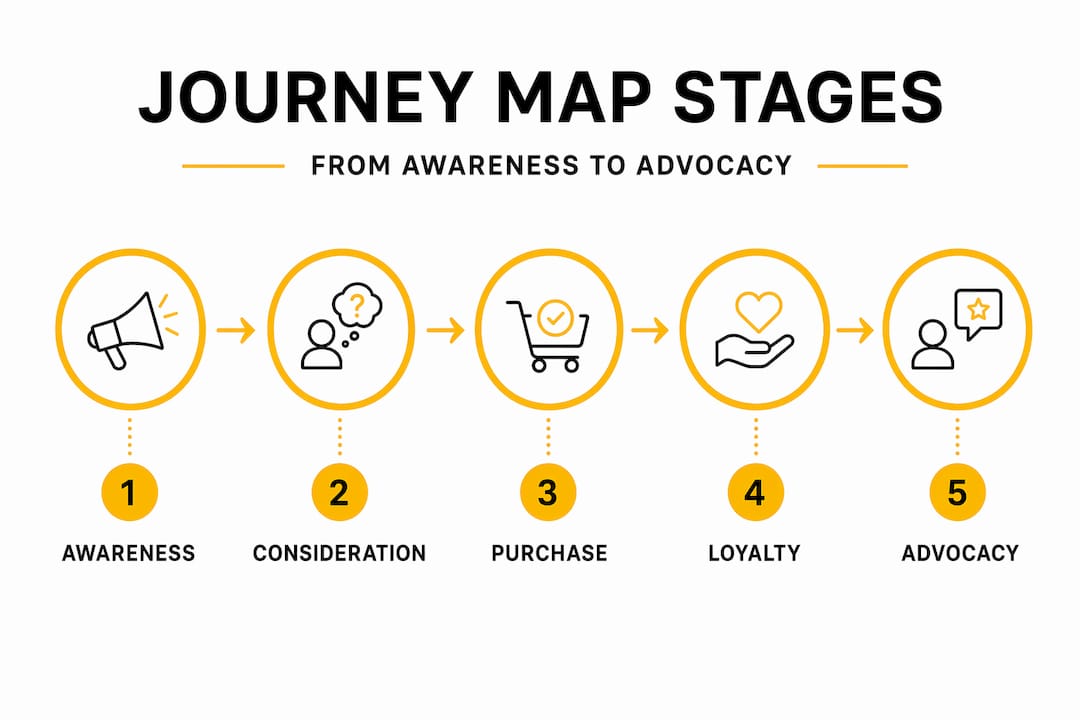
The most common customer journey stages follow a five-part arc: awareness, consideration, purchase, loyalty, and advocacy. Each stage carries distinct challenges for marketers, and the opportunities within each vary significantly by industry and business model. A SaaS company’s retention stage looks nothing like a retail brand’s. That specificity is the point.
Within each stage, the map captures:
- Touchpoints: Every interaction a customer has with your brand, from a Google ad to a support chat to a renewal email
- Emotions: What the customer feels at each step, whether confident, confused, frustrated, or delighted
- Pain points: Specific moments where friction slows or breaks the customer’s forward progress
- Channels: Where interactions happen, including web, mobile, in-store, phone, and social
Journey maps range from simple timelines to detailed multi-lane diagrams. The format matters less than what the map enables: a shared, objective view of the customer’s experience that teams across your organization can reference, debate, and act on.
Pro Tip: Start with a simple timeline format before adding complexity. A one-page map your team actually uses outperforms a 20-slide deck nobody revisits.

How to map a customer journey effectively
The process of customer journey mapping fails most often not in the mapping itself but in the steps before it. Here is how to get it right.
-
Set a clear objective. Before you draw anything, define what you are trying to understand or solve. Are you investigating why trial users drop off? Why loyal customers stop renewing? A focused objective keeps the map from becoming everything to everyone and nothing to anyone.
-
Choose the right persona. Pick one specific customer segment for this map. Attempting to represent all customers simultaneously produces an average-path trap that reflects no one’s actual experience accurately. Your persona should be grounded in behavioral data and qualitative research, not demographic assumptions.
-
Collect real customer data. This is where most teams cut corners. Interviews, usability sessions, support ticket analysis, NPS verbatims, and session recordings all surface truths that internal teams cannot see from behind their desks. Effective maps require real research to align marketing, sales, product, and support around what customers actually experience.
-
Map touchpoints and emotions together. For each stage, document every interaction the persona has with your brand. Then layer in the emotional state at each point. A customer who visits your pricing page three times before converting is not just “in the consideration stage.” They are uncertain, possibly anxious, and need reassurance. The map should capture that nuance.
-
Identify the moments that matter. Not all touchpoints carry equal weight. Linking touchpoints to emotionally critical moments early in the process, with defined success metrics attached, is what separates maps that drive change from maps that describe problems without solving them.
-
Validate and socialize the map. Share drafts with cross-functional teams, including sales, support, and product, before finalizing. Those teams will catch inaccuracies and, more importantly, they are the ones who need to act on the map’s findings.
Pro Tip: Run a “customer safari” before you map. Have team members from different departments shadow real customer interactions for one week. The insights are often more revealing than any survey.
Common pitfalls to avoid include mapping from the company’s perspective rather than the customer’s, skipping emotional data because it feels subjective, and treating the finished map as a final deliverable rather than a starting point.
Using and maintaining journey maps
Completing a journey map is not the finish line. The real work starts when you put it to use across your organization.
The single biggest mistake marketing leaders make is treating the map as a static artifact. Journey maps must evolve as customer behaviors shift, new channels emerge, and business contexts change. A map built in 2023 that has never been updated does not reflect how your customers interact with you today. Set a refresh cadence: quarterly reviews at minimum, with full rebuilds when major product or channel changes occur.
Here is how high-performing organizations put their maps to operational use:
- Prioritizing CX investments: The map surfaces which pain points have the highest frequency and the greatest emotional impact, giving you a clear basis for resource allocation
- Aligning cross-functional teams: When marketing, sales, support, and product teams reference the same map, they stop optimizing their own silos and start optimizing the customer’s experience
- Connecting to KPIs: Tying each stage and touchpoint to metrics like conversion rate, churn rate, or satisfaction score turns the map into a performance management tool
- Diagnosing service failures: When customer complaints spike, the map helps you locate exactly where the breakdown occurred instead of guessing
Pro Tip: Assign ownership of each journey stage to a specific team or leader. Maps without owners get updated by no one and used by no one.
The table below shows how journey stages connect to operational metrics and responsible teams:
| Journey stage | Key metric | Primary owner |
|---|---|---|
| Awareness | Cost per qualified lead | Marketing |
| Consideration | Trial-to-paid conversion rate | Marketing / Sales |
| Purchase | Cart abandonment rate | E-commerce / Product |
| Loyalty | Net Promoter Score (NPS) | Customer Success |
| Advocacy | Referral rate | CX / Marketing |
This kind of customer experience mapping tied to ownership and metrics is what separates organizations that learn from their maps from those that archive them.
Segmenting journeys and measuring impact
Here is an uncomfortable truth most journey mapping guides skip: a single journey map is often the least useful kind. Executive teams frequently push for one definitive map. That instinct, while understandable, produces a document representing the average customer who does not actually exist.
Segmenting by persona and usage scenario generates far more precise and actionable insights. A B2B enterprise buyer evaluating software for 18 months has almost nothing in common with an SMB owner who signs up in an afternoon. Mapping them together obscures what each group actually needs from you.
The same principle applies to scenarios. A customer who comes to you through a referral enters your experience with a different emotional baseline than one who clicks a cold ad. Map both. The contrast reveals leverage points that a blended map would hide entirely.
| Map type | Strengths | Best use case |
|---|---|---|
| Single persona map | Focused, fast to build | Initial exploration of one key segment |
| Multi-persona map | Reveals segment differences | Comparing high-value vs. entry-level buyers |
| Scenario-based map | Captures context variation | Referral vs. inbound vs. outbound acquisition |
| Current state map | Reflects real experience | Diagnosing existing friction and failures |
| Future state map | Defines ideal experience | Planning CX improvements and product changes |
On the measurement side, customer journey analysis tools allow you to visualize actual customer behavior across channels sequentially. That means tracking what happens across your call center, point-of-sale, website, and app in one connected view. Pairing that quantitative data with the qualitative insight from your journey map creates a feedback loop that continuously surfaces where customer progress is stalling.
Focusing on journeys with the highest business impact rather than mapping every possible path is how organizations get measurable returns from this work. Prioritize journeys tied to high-revenue segments, high-churn risk, or high complaint volume. Those are the maps that pay for themselves.
Pro Tip: Score each journey by two dimensions: frequency (how many customers take this path) and impact (how much friction or delight it generates). Map the high-frequency, high-impact journeys first.
For marketing leaders who want to connect their CX measurement approach to journey mapping, the combination of behavioral analytics and map-level insights is where the real competitive advantage lives.
My take: journey maps are a means, not the destination
I have worked with organizations that built extraordinarily detailed journey maps. Beautifully designed, thoroughly researched, full of data. And then those maps sat in a shared drive for two years, untouched.
What I have learned from watching this pattern repeat is that the goal was never the map. The goal is faster, easier, less painful customer progress. When journey mapping does not connect to that goal, it becomes exactly what one CMSWire article memorably called “corporate wallpaper.”
In my experience, the organizations that extract real value from journey mapping share one habit: they treat the map as an input to decision-making, not a deliverable. They assign it owners. They argue about it in planning meetings. They update it when the data tells them something has changed. That friction and ongoing engagement is a sign the map is working.
The advice I give to marketing leaders is this: resist the urge to create something beautiful and comprehensive right away. Build something honest and specific. A narrow, accurate map of your highest-stakes journey is worth ten polished maps of journeys nobody is responsible for improving. Complexity is easy. Honest, operational clarity is rare. That is where the value lives.
— Daniela
How Altiam CX helps you put journey mapping to work
Understanding what customer journey mapping is and doing something with it are two very different things. The gap between insight and execution is where most organizations lose momentum.

Altiam CX partners with businesses to close that gap. Through nearshore customer care, technical support, and back-office operations, Altiam CX helps organizations act on what their journey maps reveal. When a software platform needed to address critical friction in its technical support journey, migrating to Altiam CX improved productivity by 89%. In another case, an orthodontic services provider used targeted CX improvements to measurably improve customer experience outcomes. If you are ready to turn your journey map into a performance engine, explore how Altiam CX’s nearshore solutions can help your team execute with speed and precision.
FAQ
What is customer journey mapping in simple terms?
Customer journey mapping is the process of visualizing every step a customer takes with your brand, including their emotions and pain points at each stage, so your team can identify and fix friction points.
What are the main customer journey stages?
Most frameworks include five stages: awareness, consideration, purchase, loyalty, and advocacy. Each stage presents distinct opportunities and challenges for marketers and CX teams.
How many journey maps does a company need?
There is no fixed number. Most organizations benefit from multiple maps segmented by persona and scenario rather than one universal map, which tends to reflect no single customer’s actual experience accurately.
What tools support customer journey mapping?
Journey mapping tools range from whiteboarding platforms and dedicated CX software to cross-channel analytics platforms. The most effective setups pair a visual mapping tool with behavioral analytics that show how customers actually move through your defined stages.
What makes a customer journey map ineffective?
Maps fail when they are built on assumptions instead of real customer research, when they lack emotional data, when they are not connected to success metrics, or when no team member is assigned responsibility for acting on what the map reveals.