
TL;DR:
- Streamlining support reduces costs by 15-50% and improves compliance, service, and satisfaction.
- Nearshore outsourcing offers proximity benefits, boosting real-time collaboration and regulatory compliance.
- Continuous measurement and strategic modeling are essential for successful long-term support optimization.
Support operations are still widely treated as a necessary expense. That assumption is costing executives real money. Organizations that strategically streamline their support structures can reduce costs by 15-50% through nearshore outsourcing while simultaneously improving compliance, service quality, and customer satisfaction. This article breaks down what modern streamlining actually looks like, why it matters across healthcare, legal, and e-commerce sectors, and how proven methodologies and nearshore models can turn your support function from a budget line into a measurable competitive advantage.
Table of Contents
- What does streamlining support operations mean today?
- The business case: Quantifiable benefits for healthcare, legal, and e-commerce
- The nearshore edge: Why proximity matters for modern support
- How to streamline: Proven methodologies and real-world pitfalls
- Our perspective: What most executives overlook when streamlining support
- Start streamlining your support with Altiam CX
- Frequently asked questions
Key Takeaways
| Point | Details |
|---|---|
| Massive cost savings | Streamlined support with nearshore models yields 15-50% lower costs across sectors. |
| Proven compliance boosts | Specialist support teams raise HIPAA and legal compliance while accelerating response times. |
| Customer experience gains | Unified, nearshore operations enhance customer satisfaction and first-contact resolution. |
| Smart model blending | Combining nearshore and onshore support maximizes quality and scalability. |
| Framework-driven results | Applying Lean, KPI tracking, and technology ensures sustainable streamlined operations. |
What does streamlining support operations mean today?
Streamlining is not just cutting headcount or consolidating vendors. In practical terms, it means eliminating inefficiencies, redesigning workflows, and proactively optimizing your support structure so that every interaction delivers value. The shift in thinking is significant. Where executives once viewed support as a cost center to minimize, the most competitive organizations now treat it as a value driver to optimize.
What does that look like across key industries? Consider the core goals executives are actually trying to achieve:
- Compliance: Meeting regulatory requirements in healthcare, legal, and financial services without slowing operations
- Efficiency: Reducing average handle time (AHT) and eliminating redundant processes
- Cost control: Achieving measurable savings without sacrificing service quality
- Customer experience (CX): Improving satisfaction scores and first-contact resolution (FCR) rates
- Scalability: Building support structures that grow with demand without proportional cost increases
Many executives misunderstand the scope of streamlining. They assume it applies only to call center volume or ticket routing. In reality, it spans back-office operations, compliance workflows, intake processes, and team structure. A CX outsourcing strategic guide for regulated industries shows just how broad the opportunity is.
The nearshore outsourcing explained model has become a central mechanism for achieving these goals. It delivers cost savings of 15-50% while improving efficiency and compliance simultaneously. That combination is rare. Most cost-reduction strategies trade quality for savings. Nearshore models, when executed well, do not force that tradeoff.

The business case: Quantifiable benefits for healthcare, legal, and e-commerce
Data matters to executives. So let’s look at what streamlined support actually delivers across the three sectors where the evidence is strongest.
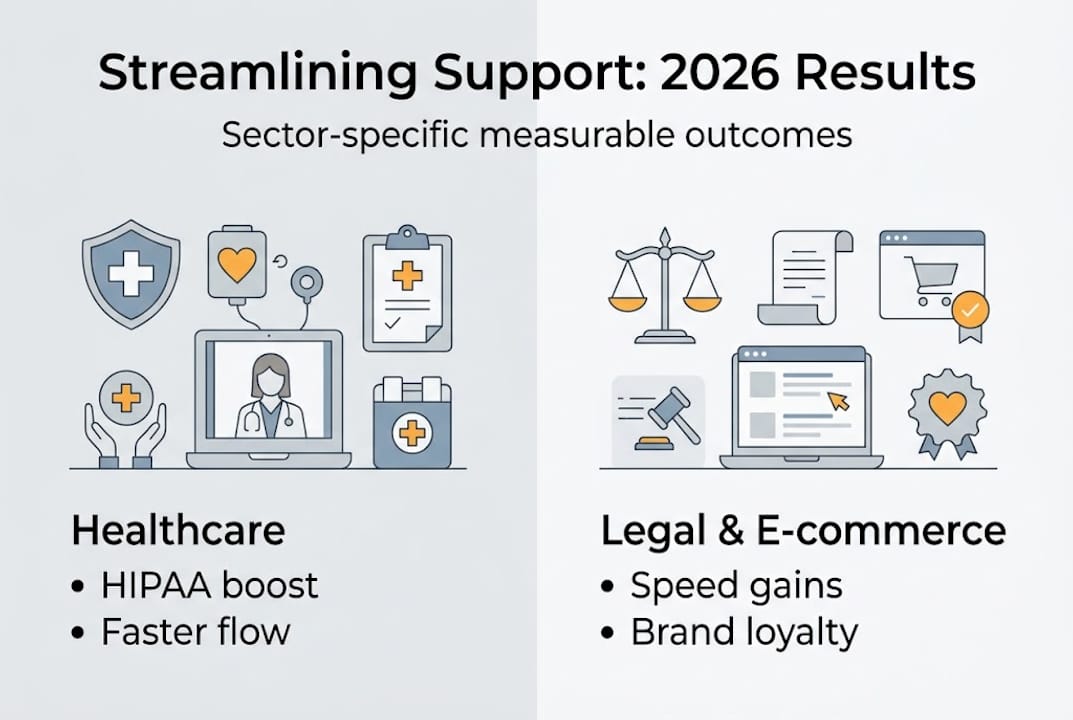
In healthcare, specialized nearshore teams have produced HIPAA compliance improvements of 78%, reduced ER wait times by 20%, and meaningfully improved patient satisfaction scores. These are not marginal gains. They represent operational transformation that directly affects patient outcomes and regulatory standing. The nearshore support benefits in this sector go well beyond cost.
In legal, the numbers are equally compelling. Firms using streamlined, outsourced support models report 30% faster compliance responses, a 15% increase in client retention, and over $1.1M in annual savings. Those figures come from real firms, not projections. Explore the legal support benefits driving this shift.
In e-commerce, omnichannel leaders grow 2x faster than single-channel peers (3.8% vs. 2.1% CAGR), and 84% of leading brands now use third-party logistics (3PL) for fulfillment. The outsourcing for CX benefits in this space are tied directly to speed, scale, and customer loyalty.
| Sector | Key benefit | Measurable outcome |
|---|---|---|
| Healthcare | Compliance and patient flow | 78% HIPAA improvement, 20% fewer ER wait times |
| Legal | Cost reduction and retention | $1.1M+ annual savings, 15% retention gain |
| E-commerce | Growth and fulfillment speed | 2x faster growth, 84% 3PL adoption |
The pattern is clear. Streamlined support is not a generic efficiency play. It produces sector-specific, quantifiable results that executives can report to boards and use to justify investment.
The nearshore edge: Why proximity matters for modern support
Not all outsourcing models deliver the same outcomes. The location of your support partner affects collaboration quality, compliance risk, and customer satisfaction in ways that are easy to underestimate.
Nearshore models offer time zone alignment and cultural fit that offshore alternatives simply cannot match. When your support team operates in overlapping hours, real-time collaboration advantages become tangible. Escalations get resolved faster. Feedback loops tighten. And customers feel the difference. Nearshore models boost FCR by 15-25% and improve CSAT scores by up to 30%.
For regulated industries, the compliance advantage is equally important. Nearshore teams trained in HIPAA, legal intake protocols, or e-commerce consumer protection standards reduce regulatory exposure in ways that offshore teams in distant time zones often cannot.
Here is how the three models compare:
| Model | Cost | Quality | Compliance fit | Scalability |
|---|---|---|---|---|
| Onshore | High | Highest | Best for sensitive work | Limited |
| Nearshore | Moderate | High | Strong for regulated sectors | Flexible |
| Offshore | Low | Variable | Weaker for compliance-heavy work | High |
The nearshore versus offshore comparison is not about declaring one model universally superior. It is about fit. Understanding nearshore partners and their operational model is essential before committing.
Hybrid models are increasingly common and often optimal. They blend nearshore coverage for mission-critical, real-time interactions with offshore support for lower-sensitivity, asynchronous work.
Pro Tip: Use nearshore teams for overlap-critical functions like compliance escalations, live chat, and intake. Reserve offshore capacity for after-hours, back-office, or documentation tasks where real-time response is not essential.
How to streamline: Proven methodologies and real-world pitfalls
Knowing the benefits is one thing. Executing a streamlining initiative without stumbling is another. Here is a practical framework based on what actually works.
Step-by-step approach:
- Map your current state. Document every support process end to end. Identify handoffs, redundancies, and bottlenecks before designing solutions.
- Set baseline KPIs. Establish current FCR, AHT, and CSAT scores. You cannot improve what you do not measure. Lean principles and KPIs like these form the backbone of any credible optimization program.
- Prioritize high-value processes. Do not try to overhaul everything at once. Start where the ROI is clearest, whether that is legal intake, patient scheduling, or e-commerce returns.
- Execute with the right model. Match the process to the right delivery model. Use team-extension approaches for specialized functions like law practice intake solutions or clinical support.
- Iterate continuously. Review KPIs monthly. Adjust staffing, scripts, and tech stack based on real data. An orthodontic CX case study shows how iterative improvement compounds over time.
Common pitfalls are worth naming directly. Many organizations underestimate workforce management (WFM) complexity. High turnover in nearshore environments requires strong WFM and quality assurance (QA) systems to maintain consistency. Others blend nearshore and offshore models without defining clear scope boundaries, which creates confusion and quality gaps.
“The biggest risk in support streamlining is not moving too fast. It is moving without a measurement framework. Without KPIs anchored to business outcomes, you are optimizing in the dark.”
Pro Tip: Start with your highest-volume, highest-impact process. Prove the model there first. Then scale. Trying to transform everything simultaneously is the most common reason streamlining initiatives stall.
Our perspective: What most executives overlook when streamlining support
Most streamlining conversations start and end with cost. That is understandable. Cost is visible, measurable, and easy to report. But at Altiam CX, we have seen what happens when organizations optimize purely for savings without accounting for culture fit, quality continuity, and long-term adaptability.
Short-term savings can become long-term losses. A support model that cuts costs by 30% but degrades compliance performance in a regulated industry is not a win. It is a liability. The real value of superior CX outcomes comes from continuous improvement, not a one-time restructuring.
The executives who get the most from support streamlining are the ones who treat it as an ongoing operating discipline, not a project with a finish line. They build feedback loops. They review KPIs regularly. They hold partners accountable to outcomes, not just activity metrics. And they recognize that cultural alignment between their brand and their support team is not a soft consideration. It is a direct driver of customer retention and satisfaction.
Pure offshore models have their place, but they should be tactical, not foundational. The organizations that build their core support capability on nearshore and onshore models, then use offshore selectively, consistently outperform those that chase the lowest unit cost.
Start streamlining your support with Altiam CX
The frameworks and data in this article point to one clear conclusion: streamlined support is a strategic investment, not an operational afterthought. If you are ready to move from insight to action, Altiam CX is built to help you get there.
As a nearshore customer experience solutions partner, Altiam CX works with healthcare, legal, and e-commerce organizations to design and operate support models that reduce costs, strengthen compliance, and improve customer satisfaction. Explore our full range of CX and managed team services or visit Altiam CX to learn how we can tailor a solution to your sector’s specific needs. The results are measurable. The path is clear.
Frequently asked questions
How much can streamlining support operations save my business?
Streamlining support can reduce costs by 15-50% through nearshore models, and legal firms specifically have reported over $1.1M in annual savings after restructuring their support operations.
What are the most common mistakes when streamlining support?
The most frequent errors include underestimating workforce management complexity, skipping quality assurance systems, and failing to define clear scope boundaries between delivery models. Strong WFM and QA are essential, especially in high-turnover nearshore environments.
Why is nearshore support a better option than offshore or onshore?
Nearshore support balances cost, quality, and compliance through time zone alignment and cultural proximity. Onshore is best for the most sensitive work, while offshore suits cost-heavy, asynchronous tasks. Nearshore outperforms offshore specifically for quality and regulatory compliance.
How can support operations stay compliant in regulated industries?
Specialized nearshore teams trained in sector-specific regulations are the most reliable path to compliance. In healthcare, this approach has produced HIPAA compliance improvements of 78%, which is a substantial gain for any regulated organization.
Which KPIs matter most when streamlining support?
The three most important metrics are first-contact resolution (FCR), average handle time (AHT), and customer satisfaction (CSAT). Lean principles and these KPIs form the foundation of any effective support optimization program.