Most retail leaders understand customer care matters, but few recognize it as the primary driver of sustainable revenue growth. Research shows that customer care quality directly influences loyalty, retention, and bottom-line performance, yet many organizations treat it as a cost center rather than a strategic investment. This disconnect creates a significant competitive gap. When retail executives optimize customer care through proven frameworks, measurable behaviors, and integrated technology, they unlock predictable growth and customer lifetime value increases that far exceed initial implementation costs. This article explores actionable models and best practices to transform customer care from reactive support into a revenue-generating strategic function.
Table of Contents
- Key takeaways
- Understanding the strategic role of customer care in retail
- Measuring and improving customer care quality with the SERVQUAL/RATER model
- Balancing service models and leveraging employee proactivity for superior retail experiences
- Harnessing CRM and integrated strategies to boost customer retention and lifetime value
- Enhance your retail customer care with Altiam CX
- Frequently asked questions
Key Takeaways
| Point | Details |
|---|---|
| Strategic customer care drives revenue | Quality customer care increases loyalty, retention, and lifetime value while reducing acquisition costs. |
| SERVQUAL five dimensions | The SERVQUAL or RATER framework helps identify gaps between expectations and performance across five service dimensions to improve retail service quality. |
| Proactive employee behavior boosts spending | Proactive outreach and issue resolution boost satisfaction and revenue even when delays occur. |
| Retention gains from CRM | CRM and loyalty initiatives increase customer retention by over twenty percent. |
| Balance self and full service | Balancing self service and full service enables retailers to meet different shopper needs. |
Understanding the strategic role of customer care in retail
Customer care in retail encompasses every interaction that supports shoppers before, during, and after purchase. This includes product guidance, checkout assistance, returns processing, technical support, and proactive outreach. Unlike transactional service, strategic customer care creates personalized experiences across omnichannel touchpoints that build emotional connections and drive repeat business. When executed well, it transforms one-time buyers into loyal advocates who generate predictable revenue streams.
Exceptional customer care delivers measurable business outcomes. Retailers who invest in quality interactions see higher customer satisfaction scores, increased average order values, and reduced churn rates. These improvements compound over time as loyal customers spend more per transaction, require less acquisition cost, and refer new buyers through word-of-mouth. The competitive advantage becomes self-reinforcing because satisfied customers create barriers to competitor entry through emotional loyalty that price alone cannot overcome.
The customer journey divides into three critical stages where care quality determines outcomes:
- Pre-purchase: Shoppers need product information, comparisons, and availability confirmation to make confident decisions without friction
- During purchase: Checkout assistance, payment support, and immediate problem resolution prevent cart abandonment and build trust
- Post-purchase: Delivery updates, returns processing, and proactive issue resolution turn transactions into relationships that generate lifetime value
Retailers who excel across all three stages capture significantly higher wallet share. A customer who receives helpful pre-purchase guidance, smooth checkout support, and effortless returns processing will choose that retailer over competitors even at slightly higher prices. This loyalty premium directly impacts margins and reduces dependency on promotional discounting.
“Customer care quality creates measurable revenue impact by increasing repeat purchase rates, average order values, and customer lifetime value while simultaneously reducing acquisition costs and price sensitivity.”
The strategic value extends beyond individual transactions. Customer care teams generate insights about product issues, process friction, and unmet needs that inform merchandising, operations, and marketing decisions. This feedback loop enables continuous improvement and keeps retailers aligned with evolving customer expectations. Organizations that recognize the role of customer care teams as strategic intelligence sources gain competitive advantages that purely product-focused competitors miss.
Measuring and improving customer care quality with the SERVQUAL/RATER model
The SERVQUAL framework, often abbreviated as RATER, provides a validated methodology for measuring service quality across five dimensions. Developed through extensive research, this model helps retail leaders identify service quality gaps between customer expectations and actual performance. Each dimension captures specific aspects of service delivery that collectively determine perceived quality.
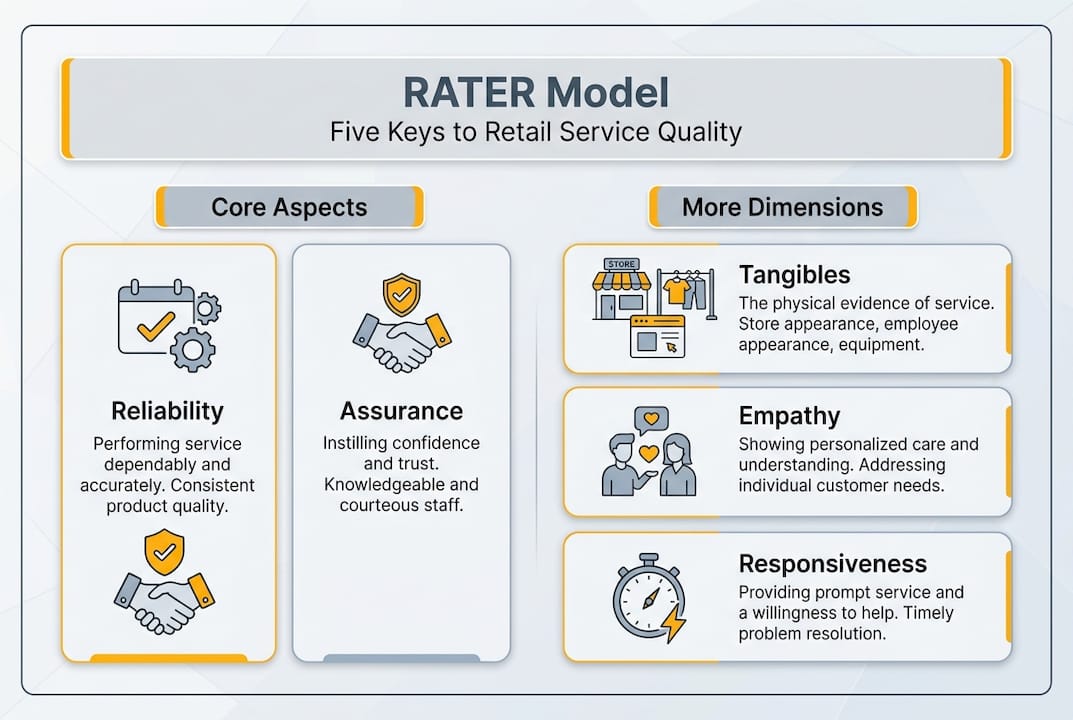
| Dimension | Definition | Retail Application |
|---|---|---|
| Reliability | Ability to perform promised service dependably and accurately | Consistent product availability, accurate order fulfillment, dependable delivery windows |
| Assurance | Knowledge and courtesy of employees and their ability to convey trust | Expert product recommendations, secure payment processing, confident problem resolution |
| Tangibles | Physical facilities, equipment, and appearance of personnel | Store cleanliness, modern checkout technology, professional staff presentation |
| Empathy | Caring, individualized attention provided to customers | Personalized product suggestions, flexible return policies, recognition of repeat customers |
| Responsiveness | Willingness to help customers and provide prompt service | Quick checkout processing, immediate response to questions, fast issue resolution |
Retailers implementing the RATER model typically survey customers to rate expectations and perceptions for each dimension. The gap between these scores reveals specific improvement opportunities. A large gap in responsiveness, for example, signals the need for additional staff during peak hours or better queue management technology. This precision prevents wasted investment in areas already meeting expectations.
Service quality measurement frameworks like RATER enable continuous improvement by establishing baseline performance and tracking progress over time. Retailers should measure quarterly to detect seasonal patterns and assess initiative effectiveness. The data also supports benchmarking against competitors and industry standards to maintain competitive positioning.
Pro Tip: Survey customers immediately after interactions using brief, dimension-specific questions to capture accurate perceptions while experiences remain fresh. Aggregate monthly to identify trends without overwhelming customers with survey fatigue.
The model’s power lies in its ability to translate subjective service quality into actionable metrics. Rather than vague directives to “improve customer service,” RATER identifies that responsiveness scores dropped 15% due to longer checkout wait times. This specificity enables targeted solutions like additional staffing, self-checkout expansion, or mobile point-of-sale deployment. The framework also helps prioritize investments by revealing which dimensions have the largest gaps and greatest impact on overall satisfaction.
Retailers who master customer care fundamentals through systematic measurement gain predictable control over service quality. They can forecast satisfaction scores based on operational inputs, adjust resource allocation to maintain standards during demand spikes, and demonstrate ROI from service improvements through tracked metric changes. This analytical approach transforms customer care from an art into a manageable, scalable business process.
Balancing service models and leveraging employee proactivity for superior retail experiences
Retail service models exist on a spectrum from pure self-service to full-service concierge experiences. The optimal model depends on customer segment, product complexity, and price positioning. Self-service models minimize labor costs by empowering customers to browse, select, and checkout independently with minimal staff interaction. Full-service models provide dedicated assistance throughout the shopping journey, adding significant labor cost but enabling premium pricing and deeper customer relationships.
| Feature | Self-Service Model | Full-Service Model |
|---|---|---|
| Staffing level | Minimal, focused on stocking and checkout | High, with dedicated sales associates per customer |
| Customer expectation | Low prices, efficiency, convenience | Personalized attention, expert guidance, premium experience |
| Typical retail contexts | Supermarkets, discount stores, warehouse clubs | Luxury boutiques, specialty stores, high-end department stores |
| Cost structure | Low labor cost, high transaction volume | High labor cost, lower volume, higher margins |
| Loyalty drivers | Price, convenience, speed | Relationships, expertise, exclusive service |
| Technology emphasis | Self-checkout, mobile apps, automated inventory | CRM systems, clienteling tools, appointment scheduling |
Many retailers successfully blend elements from both models. A grocery chain might offer self-checkout for routine purchases while staffing specialty departments like seafood or bakery with knowledgeable associates. This hybrid approach optimizes labor allocation by matching service intensity to product complexity and customer willingness to pay for assistance. Supplementary services like extended warranties, installation support, and loyalty programs enhance retention across both models by adding value beyond the core transaction.
Employee behavior significantly impacts customer perceptions regardless of service model. Research demonstrates that proactive employee actions increase spending and satisfaction even when operational delays occur. Proactive behaviors include anticipating customer needs, offering unsolicited assistance, providing additional product information, and communicating warmly about wait times or issues. Customers perceive proactive employees as more competent and caring, which builds trust and loyalty.
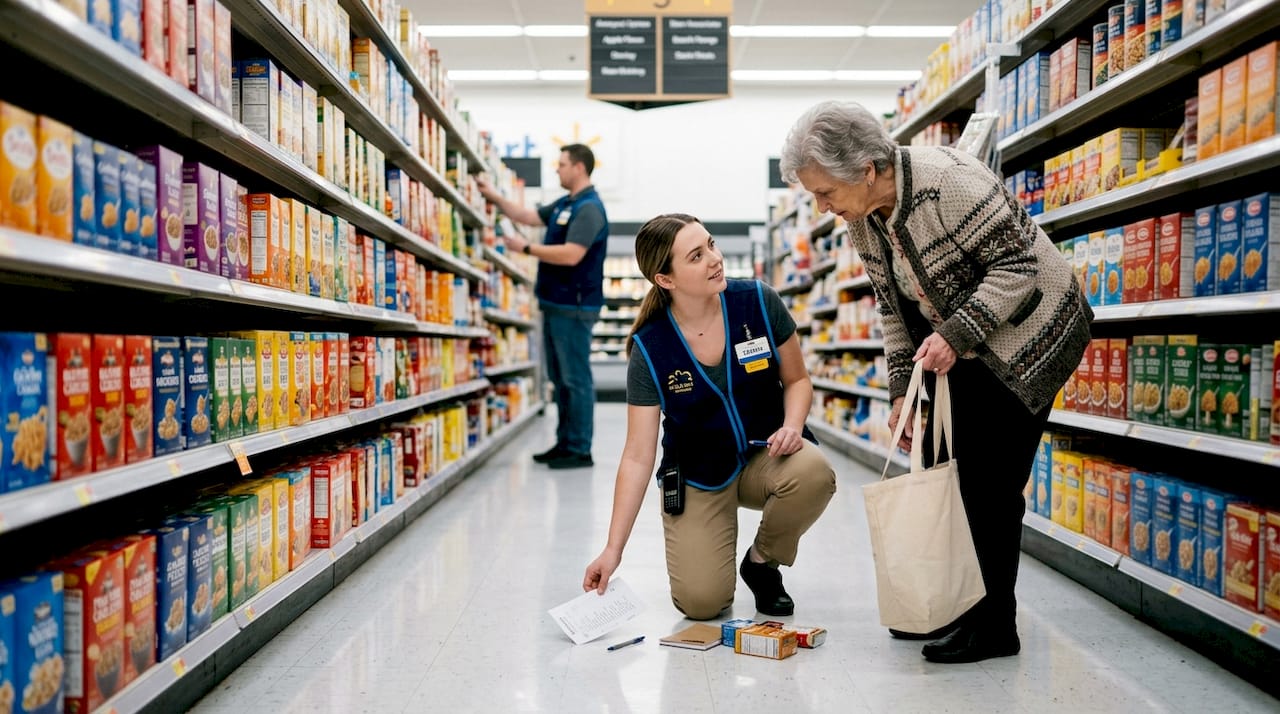
Pro Tip: Train employees to combine warmth and competence signals through both verbal and nonverbal communication. Phrases like “I noticed you’re comparing these models, let me highlight the key differences” demonstrate both attentiveness and expertise.
The impact of proactivity becomes especially valuable during service failures or delays. An employee who acknowledges a long checkout line, explains the cause, and offers an alternative solution creates positive feelings despite the negative situation. This recovery behavior often generates higher satisfaction than if no problem had occurred, a phenomenon called the service recovery paradox. Retailers who systematically train and empower employees to act proactively gain significant competitive advantages in customer retention.
Challenges exist in maintaining proactive service quality. High-stress retail environments, demanding customers, and repetitive tasks can lead to employee burnout and reduced proactive behaviors. Some customers also perceive proactive assistance as intrusive or pushy, particularly in self-service contexts where independence is expected. Successful retailers balance these tensions by training employees to read customer cues, respect boundaries, and adjust their approach based on individual preferences. This adaptive proactivity requires emotional intelligence and situational awareness that human-AI balance in CX strategies can support through technology that handles routine tasks while freeing employees for high-value interactions. Organizations seeking to systematically improve these capabilities should explore comprehensive approaches outlined in a customer care improvement guide that addresses both operational and cultural factors.
Harnessing CRM and integrated strategies to boost customer retention and lifetime value
Modern customer relationship management systems integrate data from multiple channels to create unified customer profiles that enable personalized engagement at scale. These platforms consolidate purchase history, browsing behavior, service interactions, loyalty program participation, and communication preferences into actionable intelligence. Retailers use this data to trigger relevant messages, customize product recommendations, and coordinate experiences across physical stores, websites, mobile apps, and contact centers.
The business impact of sophisticated CRM strategies is substantial. Studies show that CRM approaches generate 22% higher retention when combining digital channels, loyalty incentives, and personalized engagement compared to generic mass marketing. This retention improvement directly increases customer lifetime value by extending relationship duration and increasing purchase frequency. The compounding effect over multiple years creates significant valuation advantages for retailers who execute CRM excellence.
Key benefits of integrated CRM strategies include:
- Improved retention rates through timely, relevant engagement that maintains top-of-mind awareness and emotional connection
- Increased customer lifetime value by identifying upsell and cross-sell opportunities based on purchase patterns and preferences
- Consistent brand experience across all touchpoints through unified data that prevents contradictory messages or redundant outreach
- Reduced marketing waste by targeting high-propensity segments with tailored offers rather than broad, low-conversion campaigns
- Enhanced customer insights that inform merchandising, pricing, and service decisions through aggregated behavioral data
Implementing effective CRM-driven retention requires systematic execution across five critical practices:
- Data integration: Connect point-of-sale systems, e-commerce platforms, customer service software, and marketing automation to eliminate data silos and create complete customer views
- Personalization: Use purchase history and preferences to customize product recommendations, promotional offers, and communication content for individual customers
- Omnichannel coordination: Ensure consistent experiences when customers move between channels by sharing context and maintaining conversation continuity
- Loyalty incentives: Design rewards programs that recognize valuable behaviors like repeat purchases, referrals, and social engagement with tiered benefits that encourage progression
- Continuous feedback loops: Collect post-interaction feedback, analyze satisfaction drivers, and rapidly implement improvements based on customer input
The synergy between CRM capabilities and employee proactivity amplifies results. When frontline staff access customer profiles showing purchase history and preferences, they can provide personalized service that feels intuitive rather than intrusive. A sales associate who greets a returning customer by name and asks about their recent purchase demonstrates care that generic service cannot match. This combination of technology-enabled intelligence and human warmth creates memorable experiences that drive loyalty.
Many retailers lack the internal resources or expertise to fully leverage CRM potential while maintaining operational focus. Optimizing customer care through nearshore support provides access to specialized talent and scalable capacity without the overhead of building in-house teams. Nearshore partners bring CRM expertise, multilingual capabilities, and cultural alignment that enables rapid deployment of sophisticated retention strategies. This approach allows retail leaders to focus on core merchandising and growth initiatives while ensuring customer experience excellence through professional nearshore customer experience outsourcing partnerships.
Enhance your retail customer care with Altiam CX
Transforming customer care from a cost center into a strategic growth driver requires specialized expertise, scalable resources, and proven frameworks. Altiam CX partners with retail organizations to design and deliver customer experience solutions that measurably improve service quality, increase retention, and reduce operational costs. Our nearshore model combines cultural alignment with North American markets, disciplined execution frameworks, and flexible capacity that scales with seasonal demand.

We specialize in omnichannel customer care that integrates voice, chat, email, and social media support with your existing systems and processes. Our teams bring retail industry expertise across specialty, apparel, home goods, and consumer electronics categories. By leveraging our nearshore customer experience outsourcing capabilities, you gain immediate access to trained professionals who deliver consistent brand experiences while you maintain strategic control. Explore our complete range of nearshore CX services or review our customer care improvement guide to discover how we help retail leaders achieve measurable results.
Frequently asked questions
What is the role of customer care in retail?
Customer care drives retail success by building loyalty through personalized support across pre-purchase, purchase, and post-purchase stages. Quality care increases repeat purchase rates, average order values, and customer lifetime value while reducing acquisition costs. Understanding customer care fundamentals helps retailers recognize it as a strategic revenue driver rather than a cost center.
How do you measure customer care quality effectively?
The SERVQUAL/RATER model measures five dimensions: reliability, assurance, tangibles, empathy, and responsiveness. Survey customers to rate expectations and perceptions for each dimension, then calculate gaps to identify specific improvement opportunities. Regular quarterly measurement enables tracking progress and benchmarking against competitors.
What is the difference between self-service and full-service retail models?
Self-service models minimize labor costs by enabling independent shopping with minimal staff interaction, fitting price-focused segments like supermarkets. Full-service models provide dedicated personal assistance throughout the journey, supporting premium pricing in luxury boutiques and specialty stores. Many retailers blend elements from both approaches based on product complexity and customer segment.
How does employee proactivity impact customer satisfaction?
Proactive employees who anticipate needs, offer unsolicited assistance, and communicate warmly increase customer spending and satisfaction even during service delays. This behavior signals competence and care, building trust that drives loyalty. Training staff to balance warmth and competence while reading customer cues maximizes positive impact.
Why are CRM strategies important for retail customer retention?
CRM systems integrate data across channels to enable personalized engagement, consistent experiences, and targeted offers that generate 22% higher retention rates. They increase lifetime value by identifying upsell opportunities and maintaining emotional connections through relevant communication. Effective CRM combines technology-enabled intelligence with human service to create memorable experiences that competitors cannot easily replicate.