
TL;DR:
- A nearshore compliance framework unifies legal, security, and operational controls to ensure audit readiness and risk mitigation.
- Implementing it involves embedding compliance into development practices, enforcing legal and technical controls, and maintaining continuous monitoring.
A nearshore compliance framework is the integrated set of policies, controls, and operational processes that govern cross-border technology and services engagements with legal, security, and delivery accountability. Compliance officers and legal advisors increasingly treat this framework not as a checkbox exercise but as the operational foundation for audit-ready, risk-mitigated nearshore partnerships. Standards like SOC 2, ISO 27001, GDPR, and PCI DSS define the compliance perimeter. Regulatory bodies including data protection authorities and tax agencies shape the enforcement environment. The shift from pure cost efficiency to operational trust now defines how organizations evaluate nearshore partners.
What is a nearshore compliance framework and why does it matter?
A nearshore compliance framework is an integrated operational governance model that unifies legal contracts, employment controls, data governance, security practices, and delivery telemetry into one auditable system. It answers a specific question every compliance officer must ask: can this cross-border engagement be governed, monitored, and defended in an audit?

The framework matters because nearshore models operate within stable, enforceable legal frameworks, lowering risks compared to offshore arrangements where legal standing can be ambiguous. That enforceability is not a minor detail. It determines whether your IP assignment holds, whether a labor dispute resolves predictably, and whether a tax authority can challenge your engagement structure.
Certifications like SOC 2 and ISO 27001 shorten due diligence timelines and signal operational maturity. They do not guarantee vendor selection alone, but they give compliance officers a documented starting point for risk assessment. The framework wraps those certifications in the operational practices that make them credible.
What are the core components of a nearshore compliance framework?
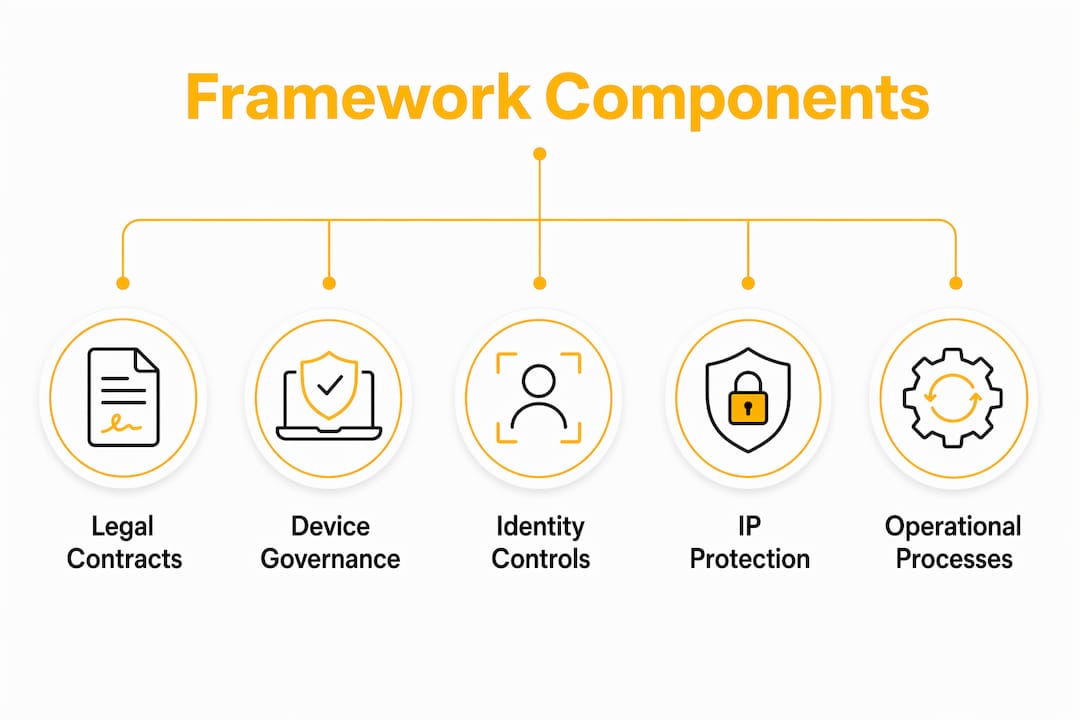
A nearshore compliance framework consolidates five operational layers into one governed system. Each layer addresses a distinct risk category that compliance officers must control.
- Legal contracts and Employer of Record (EOR) arrangements. EOR structures manage employment, payroll, and local labor law compliance on behalf of the client. They transfer legal employer liability to a registered local entity, which is critical in LATAM jurisdictions with complex labor codes.
- Device governance. Mobile Device Management (MDM) tools enforce encryption, remote wipe policies, and endpoint controls across distributed teams. Without MDM, a single lost laptop becomes a data breach incident.
- Identity and access controls. Role-based access management, multi-factor authentication, and access logging restrict who reaches sensitive systems. These controls feed directly into SOC 2 audit evidence.
- IP assignment and protection. Nearshore agreements must explicitly assign intellectual property rights to the client. Ambiguous IP clauses are among the most litigated issues in cross-border technology contracts.
- Operational telemetry and audit readiness. Nearshore compliance frameworks consolidate delivery telemetry into one governed system, transforming static audit checklists into live compliance visibility.
Pro Tip: Require your nearshore partner to provide a compliance evidence package before contract signature. This package should include MDM policy documentation, access control logs, EOR registration certificates, and the most recent SOC 2 report. If a partner cannot produce this within five business days, treat that as a governance red flag.
The five layers above are not independent. A gap in device governance undermines identity controls. A weak EOR structure creates tax exposure that no SOC 2 certification can fix. Compliance officers should evaluate all five layers together, not in isolation.
How does a nearshore compliance framework operationalize security?
Treating compliance as a final audit check is the most expensive mistake a technology organization can make. Embedding compliance controls into the software development lifecycle from the start prevents the costly remediation cycles that follow post-audit findings.
The operational approach follows a clear sequence:
- Define compliance as a design-time constraint. Security requirements, data residency rules, and access control policies enter the product backlog alongside feature work. They are not added after delivery.
- Implement DevSecOps practices. Automated security testing, secure CI/CD pipelines, and vulnerability management run continuously. Every code commit triggers a security scan, not just a quarterly review.
- Enforce role-based access and logging throughout development. Developers access only the environments their role requires. All access events are logged and retained for audit purposes.
- Deploy operational telemetry. Live dashboards replace manual compliance spreadsheets. Compliance officers see real-time evidence of control effectiveness rather than a point-in-time snapshot.
- Conduct sprint-level compliance reviews. Each sprint retrospective includes a compliance checkpoint. Teams confirm that data residency, access controls, and logging requirements were met during the sprint.
SOC 2 audits now emphasize continuous monitoring over point-in-time controls. Vendors must demonstrate operationalized security, not just documented intent. That shift changes what auditors look for and what compliance officers must verify in their vendor contracts.
Pro Tip: Add a compliance sprint review clause to your nearshore service agreement. Require the partner to share telemetry reports at each sprint close. This gives you ongoing audit evidence without waiting for an annual assessment.
Most LATAM financial services providers have built SOC 2-ready practices and secure coding standards into their delivery frameworks. That baseline makes GDPR and HIPAA alignment faster to achieve because the foundational controls already exist.
What are the benefits of nearshore compliance frameworks compared to offshore models?
Nearshore compliance frameworks deliver advantages that offshore models structurally cannot replicate. The differences are legal, operational, and practical.
Legal and regulatory alignment
Nearshore partners in LATAM operate under legal systems that share treaty relationships, data protection principles, and labor law structures compatible with US and EU regulatory requirements. Nearshore compliance reduces risks related to tax, labor disputes, and IP ownership through stable and enforceable jurisdictions. Offshore arrangements in jurisdictions with weak IP enforcement or inconsistent labor law create legal exposure that no contract clause fully eliminates.
GDPR and HIPAA alignment is faster with nearshore partners because data residency controls, consent management, and breach notification obligations map more cleanly onto compatible legal frameworks. Offshore models often require additional contractual layers, standard contractual clauses, and supplementary transfer impact assessments that add months to contracting timelines.
Operational and practical advantages
- Timezone overlap enables real-time communication during audits, incident response, and compliance reviews. A security incident at 2:00 PM Eastern reaches a LATAM team during their working hours, not the next morning.
- Cultural alignment reduces miscommunication in compliance documentation, audit responses, and governance meetings. Shared business norms accelerate decision-making.
- Faster audit response cycles. When auditors request evidence, nearshore teams can respond within the same business day. Offshore teams in distant time zones routinely add 24–48 hours to every evidence request cycle.
- Reduced operational friction. Nearshore compliance frameworks increase trust through enforceable legal jurisdictions, which is the foundation compliance officers need to recommend a vendor to their board.
The benefits of nearshore outsourcing extend beyond cost. Legal stability and governance clarity are the factors that determine whether a nearshore engagement survives its first compliance audit.
What best practices ensure effective nearshore compliance implementation?
Effective implementation requires governance decisions made before the first line of code is written. Reactive compliance is always more expensive than proactive governance.
- Align on security requirements during onboarding. Define data classification policies, access control standards, and incident escalation pathways in the first two weeks of engagement. Do not wait for a security questionnaire to surface these requirements.
- Embed compliance roles into delivery rituals. Assign a compliance liaison on both the client and partner side. That person attends sprint reviews, reviews telemetry reports, and owns the audit evidence log.
- Write explicit contract terms. Vendor agreements must define liability caps, cyber insurance requirements, indemnifications, and contractual security obligations. Vague contract language is the leading cause of post-incident disputes in nearshore engagements.
- Schedule continuous compliance reviews. Security requirements evolve. A quarterly compliance review cycle keeps the framework current with new regulatory guidance, updated SOC 2 criteria, and emerging threat vectors.
- Use telemetry for transparent reporting. Share operational telemetry reports with your legal and compliance teams monthly. Transparent reporting builds internal confidence and accelerates future vendor approvals.
Effective vendor evaluation requires clear ownership of security outcomes, governance for decision-making, and data regulatory responsibility embedded in the framework from day one. Compliance officers who treat vendor selection as a procurement exercise rather than a governance decision consistently face avoidable audit findings.
Pro Tip: Build a compliance scorecard for your nearshore partner evaluation. Score each vendor on EOR structure, MDM policy, SOC 2 status, IP assignment language, and telemetry capability. A numerical score makes vendor comparison defensible to your board and legal counsel.
The nearshore operational model that delivers long-term value is one where compliance is not a vendor promise. It is a contractually defined, continuously monitored, and regularly reported operational reality.
Key Takeaways
A nearshore compliance framework succeeds only when legal contracts, device governance, identity controls, IP protection, and operational telemetry function as one integrated system rather than separate vendor promises.
| Point | Details |
|---|---|
| Framework definition | A nearshore compliance framework integrates legal, security, and delivery controls into one auditable governance system. |
| Core components | EOR arrangements, MDM device governance, identity controls, IP assignment, and operational telemetry form the five essential layers. |
| Security operationalization | Embedding compliance into DevSecOps workflows from day one prevents costly post-audit remediation cycles. |
| Nearshore vs. offshore advantage | Enforceable jurisdictions, timezone overlap, and compatible legal frameworks give nearshore models a structural compliance edge. |
| Implementation best practice | Explicit contract terms defining liability, insurance, and audit rights are the single most important governance document in any nearshore engagement. |
Why compliance frameworks are the real test of a nearshore partner
I have reviewed enough nearshore vendor proposals to recognize a pattern. Every partner claims compliance. Very few can demonstrate it. The ones who can demonstrate it share one characteristic: they built compliance into their delivery model before a client ever asked for it.
The conventional wisdom says you evaluate a nearshore partner on cost, talent quality, and timezone fit. That framing is incomplete. A partner who cannot produce a current SOC 2 report, explain their MDM policy, or show you their access control logs is a liability, regardless of their hourly rate or engineering credentials.
Security has moved from a cost optimization metric to a board-level operational trust issue. That shift changes the vendor selection conversation entirely. Compliance officers who understand this ask different questions during procurement. They ask for telemetry access, not just certifications. They ask for contract language on audit rights, not just a security questionnaire.
The partners worth selecting are the ones who welcome those questions. They have already operationalized the answers. The partners who deflect or delay are telling you something important about how they will behave when an actual audit arrives.
Nearshore compliance frameworks are not a vendor differentiator. They are the minimum standard for any engagement that touches regulated data, customer information, or proprietary technology. Treat them accordingly.
— Daniela
Altiamcx supports compliance-driven nearshore operations
Compliance officers and legal advisors need more than a vendor who claims governance capability. They need a partner who has built it into every engagement from day one.

Altiamcx delivers nearshore team extension solutions built on measurable performance frameworks, cultural alignment, and disciplined execution. Every engagement includes defined escalation pathways, transparent reporting, and operational controls that support audit readiness. Altiamcx combines customer care, technical assistance, and back-office operations into one governed delivery model that reduces friction and builds long-term operational trust. For organizations ready to move beyond vendor promises and into verified compliance performance, Altiamcx is the partner built for that standard.
FAQ
What is a nearshore compliance framework?
A nearshore compliance framework is an integrated governance model that combines legal contracts, device management, identity controls, IP assignment, and operational telemetry to manage cross-border engagements with full audit accountability.
How does a nearshore compliance framework differ from offshore compliance?
Nearshore frameworks operate within stable, enforceable legal jurisdictions that reduce tax, labor, and IP risks. Offshore models often involve ambiguous legal standing that increases compliance exposure and slows audit response times.
What standards apply to nearshore compliance frameworks?
SOC 2, ISO 27001, GDPR, and PCI DSS are the primary standards that nearshore compliance frameworks address. Most LATAM providers have built SOC 2-ready practices and secure coding standards directly into their delivery models.
How do you implement a nearshore compliance framework effectively?
Effective implementation requires aligning on security requirements during onboarding, embedding compliance roles into sprint reviews, writing explicit contract terms covering liability and audit rights, and using operational telemetry for continuous compliance visibility.
Why is operational telemetry critical in nearshore compliance?
Operational telemetry transforms static audit checklists into live compliance visibility, giving compliance officers real-time evidence of control effectiveness rather than a point-in-time snapshot that may not reflect current risk.