
Operational friction is one of the most expensive problems a growing business can face, yet many organizations still treat it as an unavoidable cost of doing business. The reality is different. Operational partners can reduce costs by up to 25% compared to managing everything in-house, and the best nearshore models go far beyond simple cost savings. They reshape how your teams work, how customers experience your brand, and how quickly you can scale without losing quality. This guide breaks down what operational services partners actually do, why businesses across healthcare, legal, e-commerce, and finance are turning to them, and what separates a high-performing partner from a vendor that just fills seats.
Table of Contents
- What is an operational services partner?
- Why businesses are turning to operational partners
- How operational partners drive efficiency gains
- What to look for in an operational services partner
- Real-world outcomes: Case studies and success metrics
- Ready to transform your operations?
- Frequently asked questions
Key Takeaways
| Point | Details |
|---|---|
| Cut operational friction | Partnering with specialists streamlines processes and reduces barriers to growth. |
| Boost efficiency and CX | Operational partners deliver productivity gains and higher customer satisfaction scores. |
| Scale with confidence | Nearshore partners offer flexible, secure, and compliant support for growing organizations. |
| Choose wisely | Success depends on selecting a partner with relevant experience, cultural alignment, and a track record of measurable outcomes. |
What is an operational services partner?
Now that we understand the growing importance of tackling operational friction, let’s clarify what an operational services partner really is and how this role supports your core business.
An operational services partner is a specialized external provider that manages customer experience, administration, and back-office functions on your behalf. But the word “partner” matters here. This is not a simple vendor relationship where you hand off tasks and hope for the best. A true partner integrates with your workflows, aligns with your goals, and operates as a functional extension of your internal team.
The distinction between outsourcing and partnership is strategic. Outsourcing focuses on task delegation. Partnership focuses on shared outcomes, continuous improvement, and measurable performance. Businesses see productivity gains when operational partnerships are strategically aligned rather than transactional.
Services typically covered by an operational partner include:
- Customer support and care: Handling inbound inquiries, complaints, and escalations across channels
- Intake and data processing: Managing forms, applications, and records with accuracy and speed
- Technical assistance: Providing proactive IT support and troubleshooting for end users
- Back-office operations: Billing, compliance documentation, and administrative workflows
- Team extension: Scaling specialized staff quickly without the overhead of full-time hiring
Exploring examples of back-office solutions shows just how broad and customizable these services can be across different industries.
Pro Tip: The most successful teams treat their operational partner as a true extension of their business. That means sharing performance data, aligning on KPIs, and including the partner in strategic planning conversations, not just execution.
Why businesses are turning to operational partners
With a clear definition in mind, let’s uncover specifically why so many businesses across different sectors are partnering with operational service providers.
The triggers are consistent across industries. Rapid growth creates staffing gaps. Regulatory complexity demands specialized expertise. Cost pressure forces leaders to find smarter ways to deliver quality service. And skill shortages make it nearly impossible to hire and retain the right talent fast enough.

Nearshore operational partners cut friction and overhead while boosting service quality, making them a practical answer to all four of these pressures simultaneously. The external CX partner benefits extend well beyond cost, touching customer satisfaction scores, resolution times, and team morale.
| Business challenge | How a partner helps |
|---|---|
| Rapid growth | Scales teams up quickly without long hiring cycles |
| Regulatory complexity | Brings built-in compliance expertise for your sector |
| Cost pressure | Reduces overhead through efficient nearshore staffing |
| Skill gaps | Provides access to trained, specialized talent immediately |
| Service quality issues | Applies proven CX frameworks and performance metrics |
In healthcare, operational partners handle patient intake, scheduling support, and billing inquiries, freeing clinical staff to focus on care. In legal, they manage document processing and appointment setting. In e-commerce, they absorb order support volume during peak seasons without sacrificing quality. Managed services providers across sectors confirm that this model consistently outperforms reactive, in-house-only approaches.
“Outsourcing CX functions can significantly improve customer satisfaction scores when the right partner is selected and integrated properly.”
The nearshore outsourcing benefits also include cultural alignment and time zone compatibility, two factors that directly affect communication quality and customer experience.
How operational partners drive efficiency gains
Understanding the reasons is key, but how exactly do operational partners deliver these efficiency gains? Let’s break it down with examples and evidence.
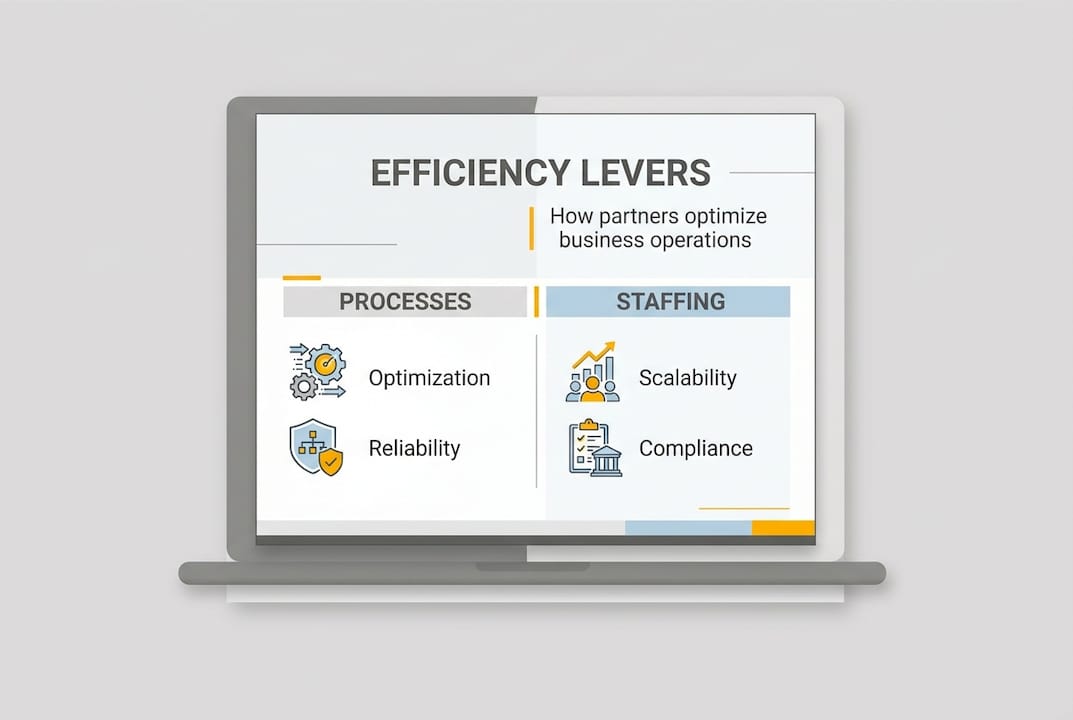
Partners drive efficiency through three core mechanisms: process optimization, scalable staffing, and compliance reliability. Each one compounds the others.
In-house vs. partnered operations
| Factor | In-house only | With operational partner |
|---|---|---|
| Staffing flexibility | Limited by hiring cycles | Scales up or down on demand |
| Compliance expertise | Varies by team | Built into partner’s core offering |
| Cost per interaction | Higher fixed overhead | Lower variable cost model |
| Speed to resolution | Dependent on internal capacity | Optimized through dedicated workflows |
| Technology integration | Often fragmented | Standardized and performance-tracked |
Here is how a typical efficiency partnership unfolds from start to results:
- Discovery and scoping: The partner audits your current workflows and identifies friction points
- Onboarding and training: Teams are trained on your brand standards, tools, and compliance requirements
- Pilot phase: A defined scope of work launches with clear KPIs and reporting cadence
- Optimization cycle: Performance data drives continuous process improvements
- Scale: Proven workflows expand to cover more functions or higher volume
A legal platform expanded staff and drove measurable efficiency and revenue growth by following exactly this model. The results were not accidental. They came from structured onboarding, clear accountability, and a partner committed to shared outcomes.
Business process outsourcing is a proven lever for growth precisely because it removes the ceiling that internal capacity places on scaling. Pair that with a focus on operational excellence and you have a model that compounds over time. Business IT efficiency improvements often follow naturally as partners standardize technology use across functions.
What to look for in an operational services partner
Once you’ve decided to pursue a partnership, here’s how to separate top-tier operational partners from the rest.
Selecting the right nearshore partner maximizes both CX outcomes and operational efficiency. But not all partners are equal. Here is what to evaluate before signing anything.
Core selection criteria:
- Sector experience: Has the partner worked with businesses in your industry? Do they understand your regulatory environment?
- Proven results: Can they show case studies with measurable outcomes, not just testimonials?
- Cultural fit: Do their values, communication style, and work ethic align with yours?
- Risk management: How do they handle data security, compliance breaches, and service disruptions?
- Transparency: Do they offer clear SLAs (service level agreements), regular reporting, and open communication?
Practical checklist before committing:
- Review at least two sector-relevant case studies
- Confirm SLA terms are specific and enforceable
- Ask about technology integration capabilities with your existing stack
- Verify compliance certifications relevant to your industry
- Request references from clients of similar size and complexity
Pro Tip: For nearshore partners specifically, do not overlook language compatibility and time zone alignment. A partner operating in a compatible time zone with strong English proficiency will reduce miscommunication and improve response times significantly. These factors directly affect your customers’ experience.
When choosing external partners, watch for warning signs: vague promises without data, no clear data security policies, and an inability to provide references. A credible partner welcomes scrutiny. Guidance on how to choose managed services providers reinforces that due diligence at the selection stage prevents costly misalignments later.
Real-world outcomes: Case studies and success metrics
Still not sure if operational partnerships deliver tangible value? Let’s see some actual results from peer organizations.
The numbers speak clearly. A software platform improved productivity by 89% after migrating its tech support function to an operational services partner. That is not a marginal gain. It represents a fundamental shift in how the business delivers technical assistance to its users.
An orthodontic services provider improved CX drastically by leveraging nearshore partners for patient communication and scheduling support. The result was faster response times, higher patient satisfaction scores, and reduced administrative burden on clinical staff.
Key performance metrics that operational partners consistently move in the right direction:
- Speed to resolution: Faster handling of customer inquiries and support tickets
- Cost per interaction: Lower operational cost per customer touchpoint
- Customer NPS (Net Promoter Score): Higher likelihood of customers recommending your business
- First-contact resolution rate: More issues resolved without escalation
- Staff utilization: Internal teams freed to focus on higher-value work
The nearshore team extension case demonstrates how scalable staffing models allow businesses to absorb volume spikes without quality drops. The legal services appointment setting case shows how back-office support directly improves client-facing outcomes in a high-stakes sector.
These results are not limited to large enterprises. Mid-sized businesses in healthcare, legal, and e-commerce are achieving similar gains by choosing partners with the right sector expertise and performance frameworks.
Ready to transform your operations?
With these results in mind, consider how you could achieve similar gains with the right operational services partner.
Altiam CX brings sector-specific expertise, a proven track record, and a performance-driven model to every engagement. Whether you need to scale customer care, streamline back-office functions, or extend your team with specialized talent, the path forward starts with understanding what’s possible.

Explore nearshore customer experience solutions built for businesses that demand measurable results. Review the CX case study that shows what a well-executed partnership looks like in practice. When you’re ready to see the full range of CX and team extension services available, Altiam CX is ready to build a solution around your specific goals and growth stage.
Frequently asked questions
How does an operational services partner differ from traditional outsourcing?
An operational services partner acts as an integrated extension of your business, aligning on shared goals and performance metrics, while traditional outsourcing typically involves handing off isolated tasks to a vendor with limited strategic involvement. Operational service partnerships go beyond task delegation by embedding team integration and continuous improvement.
What sectors benefit most from operational services partners?
Healthcare, legal, e-commerce, and finance firms see the greatest gains due to high process complexity and strong regulatory requirements. Operational partners transform efficiency in these sectors by bringing specialized expertise that is difficult and expensive to build internally.
How quickly can we expect to see results from a partnership?
Most businesses observe efficiency and service quality gains within the first quarter after onboarding. Firms realize process improvements within months when onboarding is structured and KPIs are clearly defined from the start.
Are nearshore operational partners secure and compliant?
Reputable nearshore partners offer compliance and security frameworks equal to or better than in-house teams, often as a core part of their value proposition. Nearshore partners are selected specifically for their compliance expertise in regulated industries.
What’s the first step in evaluating an operational services partner?
Begin by reviewing the partner’s case studies, sector experience, and their ability to tailor solutions to your regulatory and process needs. Case studies and sector alignment are the most reliable indicators of whether a partner can deliver results in your specific context.