
TL;DR:
- Scalable operations enable organizations to increase output without proportional cost or complexity growth.
- Successful scaling relies on standard processes, clear ownership, technology enablement, and ongoing performance measurement.
Scalable operations are defined as an organization’s ability to increase output and handle greater demand without a proportional rise in costs, headcount, or complexity. This concept, formally known as operational scalability, is the foundation of every high-growth business strategy worth executing. Organizations like Wise, Spendesk, and Scalable.co have built entire frameworks around it because the alternative, growing by adding resources at the same rate as demand, destroys margins and creates fragile organizations. If you lead a team or manage processes at scale, understanding how operational scalability works is not optional. It is the difference between a business that compounds its efficiency and one that compounds its problems.
What is scalable operations, and what makes them work?
Operational scalability is defined as the capacity to grow operations without sacrificing performance or efficiency, even as volume increases. That definition sounds simple. The execution is not.
The core building blocks of scalable operations fall into four categories:
- Standardized, repeatable processes. Standard Operating Procedures (SOPs) are the foundation. Without documented, repeatable workflows, every new hire reinvents the wheel and every process depends on whoever created it. Duquesne SBDC confirms that scalable operations depend on process standardization and measurable workflows as non-negotiable starting points.
- Clear process ownership. Knowing who owns each process, and who makes decisions when exceptions arise, removes the single biggest bottleneck in growing organizations: the founder or senior manager who becomes a human approval queue.
- Technology enablement. Tools like SAP Business One, NetSuite, Asana, Monday.com, AWS, and Google Cloud support increased data, users, and transactions without requiring proportional infrastructure investment.
- Performance measurement. Scorecards, KPIs, and real-time dashboards make performance visible. What gets measured gets managed. What gets managed can be scaled.
The manufacturing sector demonstrates this clearly. A factory that doubles output by doubling workers and floor space is not scaling. It is replicating. A factory that doubles output by optimizing its production line, automating quality checks, and standardizing supplier intake is scaling. SaaS companies apply the same logic to infrastructure: one server upgrade serves ten times the users without ten times the engineering hours.
Pro Tip: Before investing in any new technology, document your current process in full. Automating a broken process only produces broken results faster.

How do businesses successfully scale operations?
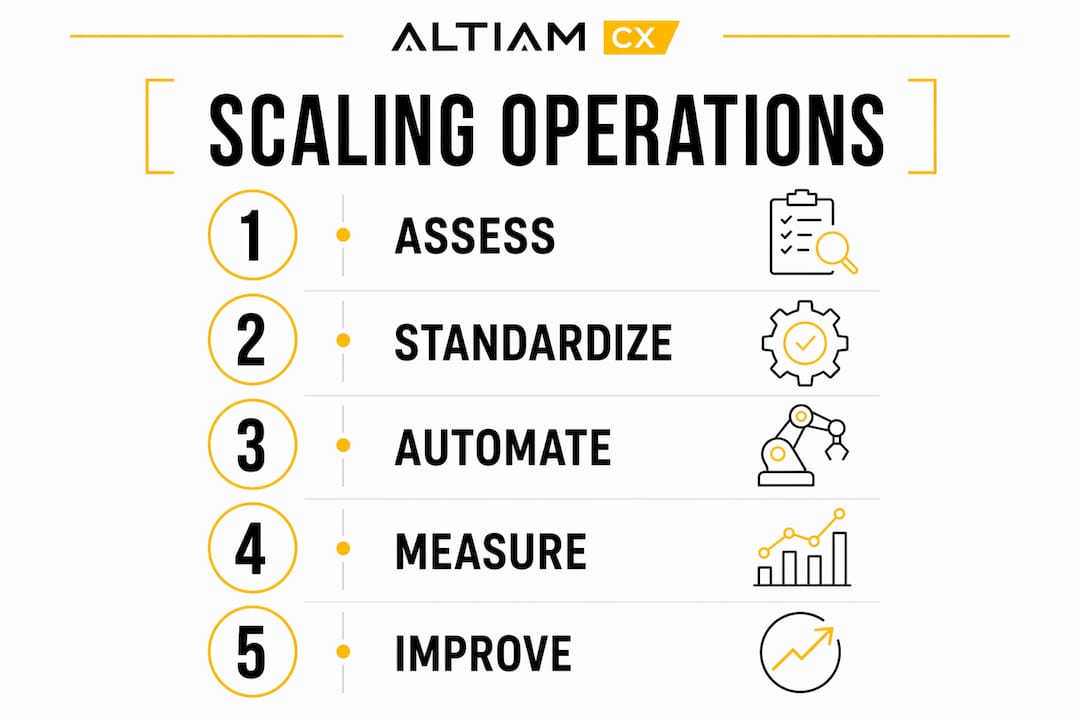
Scaling operations is not a single project. It is a continuous discipline. The most effective organizations follow a structured sequence rather than reacting to growth as it happens.
- Audit current workflows for bottlenecks. Map every process end to end. Identify where work stalls, where decisions require escalation, and where manual steps create delays. This audit is your baseline.
- Standardize and document procedures. Write SOPs for every repeatable task. Spendesk’s framework identifies seven golden rules for operational scalability, including decentralization, cloud accessibility, and intuitive software. Self-onboarding documentation is one of the most underrated tools in this list. When new employees can get up to speed without pulling senior staff away from execution, the organization scales without friction.
- Automate repetitive tasks. Automation handles volume. Orchestration handles complexity. The distinction matters. Automation replaces a single manual step. Orchestration coordinates multiple automated steps into a workflow that runs unattended, safely, with built-in controls.
- Deploy the right technology stack. ERP platforms like NetSuite or SAP Business One centralize data and process management. Workflow tools like Asana or Monday.com coordinate team execution. Cloud services like AWS or Google Cloud provide infrastructure that scales on demand.
- Establish a planning rhythm. Scalable.co’s operating system model describes a decision-making architecture that systemizes execution, optimization, and planning cadences. Weekly operational reviews, monthly performance check-ins, and quarterly strategic planning cycles create the feedback loops that prevent hidden inefficiencies from compounding.
- Iterate continuously. Growth exposes gaps. Build a culture where process improvement is a standing agenda item, not a crisis response.
The SME owner’s workflow guide from Summit Scale reinforces this sequence, noting that measurement and continuous improvement are what separate businesses that scale successfully from those that plateau.
What are the benefits and challenges of scaling operations?
The case for scalable operations is straightforward. Wise states that a scalable business can serve ten times the customers without needing ten times the employees or costs. That ratio is the entire argument. It means cost efficiency improves as volume grows, customer satisfaction stays consistent because processes are standardized, and competitive advantage compounds because margins expand while competitors struggle to keep up.
The benefits extend beyond the balance sheet. Operational scalability ensures timely deliveries in logistics, consistent service quality in customer support, and reduced stress for frontline employees who no longer operate in constant firefighting mode. That last point is underappreciated. Scalable operations protect your people as much as your margins.
The challenges are equally real.
| Challenge | What it means in practice |
|---|---|
| Resource constraints | Scaling requires upfront investment in tools, documentation, and training before the returns materialize. |
| Complexity creep | Adding employees and suppliers without disciplined process design makes operations fragile, not stronger. |
| Change adoption | Teams accustomed to informal processes resist standardization, even when it benefits them. |
| Over-automation risk | Automating the wrong processes or removing human judgment where it is needed creates new failure points. |
Spendesk identifies complexity management as the critical challenge: ensuring new growth integrates more employees and suppliers without making processes overly complex or brittle. The organizations that scale well treat complexity as a risk to be managed, not a byproduct to be accepted.
Pro Tip: Build a knowledge base before you need it. Waiting until your team is large enough to “justify” documentation means you are already behind. Every process that lives only in someone’s head is a single point of failure.
Examples of scalable operations across industries
Real-world applications make the concept concrete. Here is how operational scalability plays out across four sectors:
| Industry | Scaling mechanism | Outcome |
|---|---|---|
| Technology (Discord) | Declarative orchestration workflows with concurrency controls and rollback mechanisms | Tasks that previously required days of manual coordination now run unattended with built-in safety controls |
| Manufacturing | Standardized production lines, automated quality checks, supplier intake SOPs | Output doubles without proportional increases in labor or floor space |
| SaaS | Cloud infrastructure upgrades, automated onboarding flows, self-service support portals | User base grows without proportional growth in support headcount |
| Customer service | Team extension models, documented escalation paths, performance scorecards | Service quality stays consistent as ticket volume scales |
Discord’s 2026 engineering case study is particularly instructive. The company moved from script-based manual tasks to an orchestration layer using declarative jobs, concurrency controls, and rollback mechanisms. The result was a transformation from risky, human-dependent processes to safe, unattended workflows. That is not just a technology upgrade. It is a structural change in how the organization handles operational risk at scale.
For customer experience teams specifically, scaling support operations without sacrificing quality requires the same discipline: documented processes, clear ownership, and performance measurement built in from the start.
How to measure and sustain scalability over time
Building scalable operations is one challenge. Keeping them scalable as the organization grows is another. The Scalable.co operating system model identifies two essential layers for sustained operational efficiency: standardized execution with clear process ownership, and a continuous improvement layer with real-time scorecards and a rhythmic planning cycle.
Sustaining scalability requires these practices:
- Process mapping with ownership assigned. Every process has a named owner responsible for its performance and improvement. Without ownership, processes drift.
- Real-time scorecards and dashboards. Visibility into performance metrics at the team and process level allows managers to catch degradation before it becomes a crisis. Lagging indicators tell you what went wrong. Leading indicators tell you what is about to go wrong.
- Meeting cadences tied to data. Weekly operational reviews, monthly performance analysis, and quarterly planning cycles create the continuous measurement rhythm that prevents hidden bottlenecks from accumulating.
- Feedback loops from frontline teams. The people executing processes see inefficiencies that dashboards miss. Building structured channels for frontline input into process improvement is one of the highest-return investments an operations leader can make.
- Balancing automation with human oversight. Fully automated workflows need human review points. The goal is not to remove humans from operations. It is to remove humans from tasks that do not require human judgment.
The sustainable scalability framework from Summit Scale reinforces that SOPs and documented processes are what allow organizations to grow without operational fragility. Documentation is not bureaucracy. It is the infrastructure that makes everything else possible.
Key takeaways
Scalable operations require two layers to succeed: standardized, repeatable execution with clear ownership, and a continuous improvement system with real-time measurement and planning cadences.
| Point | Details |
|---|---|
| Core definition | Scalable operations increase output without proportional rises in cost, headcount, or complexity. |
| Foundation elements | SOPs, process ownership, technology tools, and performance scorecards are non-negotiable building blocks. |
| Scaling strategy | Audit workflows, standardize procedures, automate repetitive tasks, and establish planning rhythms before growth demands it. |
| Key benefits | Cost efficiency, consistent service quality, and reduced frontline stress compound as volume grows. |
| Sustaining scalability | Real-time dashboards, meeting cadences, and frontline feedback loops prevent hidden bottlenecks from accumulating over time. |
Why most scaling efforts stall before they succeed
I have seen organizations invest heavily in automation tools and ERP platforms, then watch their operations become more complex rather than less. The technology was not the problem. The missing piece was almost always the same: no one owned the process, and no one was measuring whether it was working.
The conventional wisdom says scaling is about technology. My experience says scaling is about discipline. The organizations that scale well are not necessarily the ones with the most sophisticated tools. They are the ones that document obsessively, assign ownership clearly, and review performance on a regular cadence. Wise’s insight that scalability is less about size and more about increasing throughput without proportional investment is the most practical framing I have encountered. It shifts the question from “how do we grow?” to “how do we grow without breaking what already works?”
The other mistake I see repeatedly is treating scalability as a destination rather than a practice. Teams reach a stable state, declare victory, and stop iterating. Then demand spikes, a key person leaves, or a new product line launches, and the cracks appear. Scalability is not a project you complete. It is a discipline you maintain. The organizations that understand this build continuous improvement into their operating rhythm from day one, not as a response to failure, but as a commitment to staying ahead of it.
— Daniela
Scale your operations with Altiamcx

Altiamcx is a nearshore customer experience and operational services partner that helps organizations expand capacity without proportional increases in cost or complexity. Whether you need customer care, technical support, or back-office operations, Altiamcx brings disciplined execution and measurable performance frameworks to every engagement. In one documented case, a software platform improved tech support productivity by 89% after migrating to Altiamcx. If you are building a scalable CX operation and want a partner with proven results, explore what Altiamcx can deliver for your team through real-world CX examples built for enterprise growth.
FAQ
What is scalable operations in simple terms?
Scalable operations refer to an organization’s ability to handle more demand, customers, or transactions without a proportional increase in costs, staff, or complexity. The goal is to grow output while keeping efficiency intact.
What are the most important components of scalable operations?
The core components are standardized SOPs, clear process ownership, technology tools like ERP and cloud platforms, and performance measurement through scorecards and KPIs. Without all four, scaling creates fragility rather than resilience.
How does scalability affect growth?
Scalability directly determines whether growth improves or erodes margins. A business that scales efficiently serves more customers at lower per-unit cost, while one that grows without scalable processes sees costs and complexity rise in proportion to demand.
What are common examples of scalable operations?
Discord’s orchestration automation, SaaS self-service onboarding, manufacturing production line standardization, and nearshore customer support team extension models are all proven examples of scalable operations across different industries.
How do you start scaling operations in your organization?
Start by auditing current workflows to identify bottlenecks, then document and standardize every repeatable process. From there, automate high-volume repetitive tasks, deploy the right technology stack, and establish a regular planning and review cadence to sustain performance as volume grows.