
Most organizations believe measuring customer experience is as simple as tracking a survey score. In reality, surveys dominate CX measurement but often lack clear linkage to business outcomes. This article explains proven methods from healthcare, legal, and e-commerce for measuring and improving customer experience success. You’ll learn which metrics actually matter, common pitfalls to avoid, and how to link your efforts to business results.
Table of Contents
- Why measuring customer experience success matters
- Essential CX success metrics: What to measure and why
- How to collect and analyze customer experience data
- Linking CX measurement to business outcomes
- Moving beyond surveys: Real-time CX intelligence and closed-loop systems
- What top performers do differently: Key takeaways and next steps
- Accelerate your CX measurement strategy with expert support
- Frequently asked questions
Key Takeaways
| Point | Details |
|---|---|
| Use multi-metric measurement | Combine NPS, CSAT, CES, and behavioral data for holistic CX insights. |
| Tie CX to business impact | Show the financial value of customer experience through conversion, retention, and ROI metrics. |
| Adopt real-time intelligence | Real-time, closed-loop systems help you act quickly and continually improve. |
| Tailor CX strategies by sector | Healthcare, legal, and e-commerce each need industry-specific measurement approaches. |
Why measuring customer experience success matters
The financial stakes of customer experience measurement are higher than most leaders realize. In healthcare alone, 68% of patients switch providers due to poor CX, resulting in a $10 billion annual loss. Legal client retention often hinges on first impressions and ongoing support quality, while e-commerce businesses face immediate revenue impact from every friction point in the customer journey.
Customer experience is no longer just a support function. It’s a strategic differentiator that impacts loyalty, retention, and financial outcomes across industries. Organizations that fail to measure CX effectively face several critical risks:
- Invisible churn patterns that erode revenue before leadership notices
- Misallocated resources fixing symptoms instead of root causes
- Competitive disadvantage as rivals optimize their customer journeys
- Inability to prove ROI on customer experience investments
“Without robust measurement frameworks, customer experience teams operate blind, making decisions based on intuition rather than evidence.”
The organizations that excel at customer experience management treat measurement as a strategic capability, not an afterthought. They build systems that capture meaningful signals, analyze patterns, and drive continuous improvement.
Essential CX success metrics: What to measure and why
Choosing the right metrics determines whether your CX program delivers real value or just generates reports. Core CX metrics include NPS, CSAT, CES, CLV, and retention rate, each serving distinct purposes in your measurement framework.
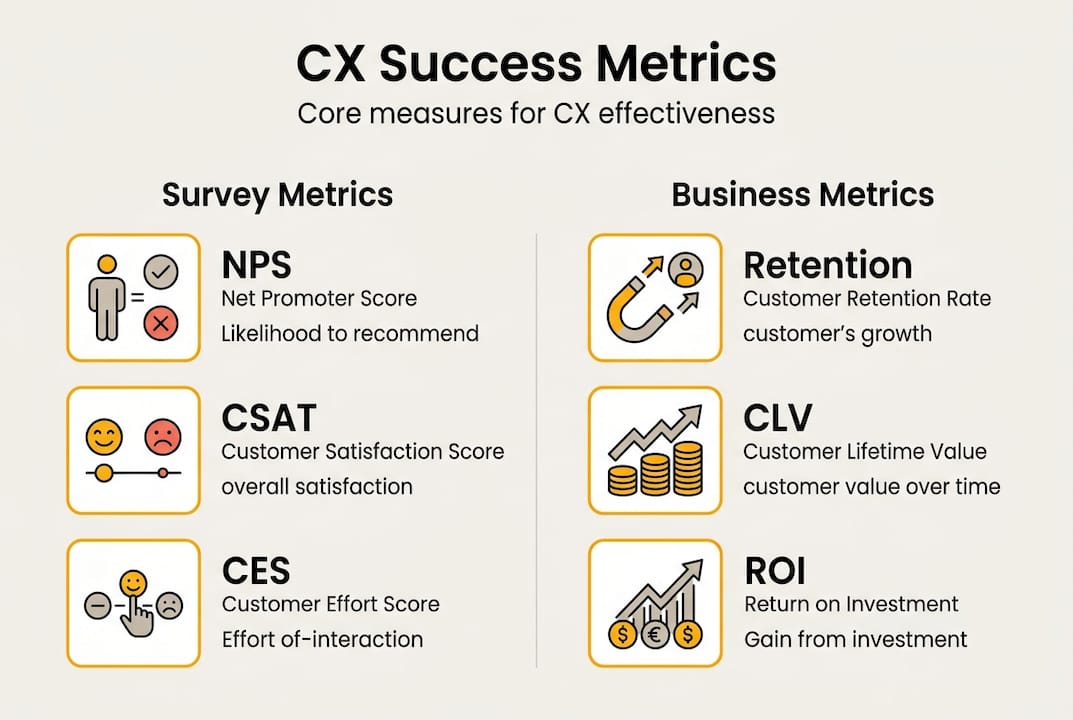
Net Promoter Score (NPS) measures customer loyalty by asking how likely customers are to recommend your service. Healthcare systems use NPS to track patient advocacy, while legal firms gauge client satisfaction with case outcomes. E-commerce brands monitor NPS to predict repeat purchase behavior.
Customer Satisfaction Score (CSAT) captures immediate reaction to specific interactions. It works well for measuring satisfaction with individual touchpoints like appointment scheduling, case updates, or checkout experiences.
Customer Effort Score (CES) quantifies how easy or difficult customers find their interactions. NPS limitations are leading organizations to alternative metrics such as CES, which often predicts retention more accurately than traditional scores.
Customer Lifetime Value (CLV) and retention rate connect CX directly to financial performance. These metrics reveal the long-term business impact of experience improvements.
| Metric | Best Use Case | Measurement Frequency | Industry Application |
|---|---|---|---|
| NPS | Overall loyalty tracking | Quarterly | Healthcare patient advocacy |
| CSAT | Transaction satisfaction | Per interaction | Legal case milestone feedback |
| CES | Friction identification | Per process | E-commerce checkout optimization |
| CLV | Financial impact | Monthly | All sectors for ROI proof |
| Retention Rate | Churn prevention | Monthly | Healthcare and legal client base |
Relying on a single metric creates blind spots. A law firm might have high CSAT scores for individual interactions while missing that clients find the overall process exhausting, leading to poor retention. An e-commerce site could celebrate strong NPS while ignoring high effort scores that predict future churn.
The most effective approach combines multiple metrics aligned to your sector goals. Healthcare organizations pair patient satisfaction scores with clinical outcome measures. Legal practices track both case satisfaction and referral rates. E-commerce businesses monitor conversion rates alongside customer effort.
Pro Tip: Start with three complementary metrics that cover different aspects of the customer journey. Add complexity only after you’ve built the discipline to act on initial insights. Many organizations collect dozens of metrics but fail to improve because they lack focus.
Different types of CX services require different measurement approaches. Technical support teams need resolution time and first-contact resolution rates. Sales teams track conversion and pipeline velocity. Back-office operations measure accuracy and processing time. Your metric mix should reflect the specific value your team delivers.
Successful healthcare CX examples demonstrate how combining clinical and experience metrics creates a complete picture. Organizations that excel at scaling professional services use metrics to identify bottlenecks and optimize resource allocation.
How to collect and analyze customer experience data
Collecting robust CX data requires strategic placement of feedback mechanisms throughout the customer journey. Surveys remain dominant but should be used with journey mapping and pattern analysis for greatest impact.
Follow this step-by-step approach to gather meaningful feedback:
- Map critical touchpoints where customer perception forms or changes
- Design brief, focused surveys that respect customer time
- Embed feedback requests into natural workflow moments
- Combine survey data with behavioral analytics for context
- Close the loop by responding to feedback and communicating changes
Healthcare organizations face unique data collection challenges. 80% of patients want nurses to communicate well and 66% want timely help, making communication quality a critical measurement area. HCAHPS surveys provide standardized benchmarks, but leading healthcare systems supplement these with real-time feedback at discharge, follow-up calls, and portal interactions.
Legal practices should collect feedback after key milestones: initial consultation, case acceptance, major developments, and final resolution. Timing matters. Asking for feedback immediately after a stressful court appearance yields different insights than waiting until case closure.
E-commerce businesses have the advantage of rich behavioral data. Track these key indicators:
| Data Type | What to Measure | Why It Matters |
|---|---|---|
| Navigation | Pages per session, bounce rate | Reveals content findability |
| Conversion | Cart abandonment, checkout completion | Identifies friction points |
| Support | Contact rate, issue type | Shows where customers struggle |
| Retention | Repeat purchase rate, time between orders | Predicts lifetime value |
Behavioral data tells you what customers do. Survey data tells you why. The combination creates actionable insights that neither source provides alone.
Pro Tip: Embed feedback collection into employee workflows, not just customer touchpoints. Front-line staff often spot patterns before they appear in data. Create simple mechanisms for team members to flag recurring issues or suggest improvements.
Effective patient experience in healthcare requires balancing clinical protocols with human connection. The best measurement systems capture both dimensions. Similarly, strong customer care strategies in retail integrate operational metrics with emotional experience indicators.
Linking CX measurement to business outcomes
Measuring customer experience without connecting it to financial performance leaves money on the table. CES improvements drive higher CX and CSAT, leading to ROI gains like 45% conversion increases, 119% ROI, and seven-month payback periods in e-commerce.

Healthcare organizations face direct financial incentives for CX excellence. Medicare ties 1.75% of reimbursements to HCAHPS scores, making patient experience a revenue factor, not just a quality measure. Hospitals that improve communication scores see both better reimbursement rates and reduced readmission penalties.
Legal firms boost client lifetime value through enhanced customer experience. A satisfied client who refers two new clients generates three times the revenue of the original engagement. Measuring referral rates and tracking them back to satisfaction scores reveals which service elements drive growth.
Calculate and report CX business value using this framework:
- Retention impact: Calculate revenue saved by reducing churn by specific percentages
- Acquisition efficiency: Measure how referrals from satisfied customers lower customer acquisition costs
- Operational savings: Quantify reduced support costs from improved first-contact resolution
- Premium pricing: Track willingness to pay more for superior experience
The biggest pitfall is ignoring long-term financial linkages. A healthcare system might celebrate improved satisfaction scores while missing that better experience reduces expensive emergency department visits. An e-commerce business could focus on conversion rate while overlooking how CX improvements increase average order value over time.
Successful organizations at CX value in retail demonstrate clear connections between experience metrics and financial outcomes. They build dashboards that show both leading indicators like satisfaction scores and lagging indicators like revenue impact. This dual view helps leadership understand both current performance and future trajectory.
Understanding profitability and CX relationships requires tracking metrics over extended periods. Short-term fluctuations matter less than sustained trends. Build measurement systems that capture both immediate feedback and long-term business results.
Moving beyond surveys: Real-time CX intelligence and closed-loop systems
Traditional survey-based measurement creates dangerous lag in fast-moving sectors. By the time you analyze quarterly NPS results, market conditions have shifted and customer expectations have evolved. Real-time CX intelligence links behavioral and feedback data, facilitating pilot-controlled improvements.
Unified, real-time dashboards give CX teams several advantages:
- Immediate problem detection before issues become patterns
- Rapid hypothesis testing through controlled experiments
- Cross-functional visibility that aligns teams around customer needs
- Predictive capabilities that forecast churn before it happens
Implementing closed-loop feedback systems transforms measurement from reporting to improvement. Closed-loop measurement-act-refine processes are recommended over relying on surveys alone. The cycle works like this: collect feedback, analyze patterns, implement changes, measure impact, refine approach, and repeat.
Healthcare systems use closed-loop systems to address patient concerns in real time. When a patient reports poor communication during their stay, the system alerts the care team immediately, allowing intervention before discharge. This prevents negative reviews and improves outcomes.
Legal practices implement closed-loop systems by tracking client sentiment throughout case progression. When satisfaction dips, case managers proactively reach out to address concerns before they escalate.
E-commerce businesses run continuous A/B tests, measuring customer response to changes in real time and iterating based on results. This approach compresses improvement cycles from months to days.
“Most organizations collect customer feedback but fail to close the loop. They measure, report, and move on. The winners measure, act, learn, and improve continuously.”
Adopting CX best practices means building systems that support rapid iteration. Modern AI-powered CX insights can identify patterns humans miss and suggest interventions based on historical data. Organizations exploring real-time CX strategies gain competitive advantage through faster response to customer needs.
What top performers do differently: Key takeaways and next steps
Top organizations use multi-metric closed-loop systems and tie results to financial outcomes for maximum effectiveness. They share several distinguishing behaviors that separate leaders from laggards.
High-performing CX teams prioritize action over analysis. They collect enough data to make informed decisions, then test improvements quickly rather than pursuing perfect information. They combine behavioral data with direct feedback to prove ROI through pilot programs.
Ready to elevate your measurement strategy? Follow these next steps:
- Audit your current metrics to identify gaps and redundancies
- Select three core metrics that align with your strategic goals
- Map critical touchpoints where you’ll collect feedback
- Build a simple dashboard that shows trends over time
- Establish a closed-loop process for acting on insights
- Pilot one improvement based on your data within 30 days
- Measure the impact and refine your approach
Pro Tip: When piloting a new metric or dashboard, start with a single team or customer segment. Prove value in a controlled environment before scaling across the organization. This approach reduces risk and builds internal credibility for broader CX initiatives.
The most successful customer experience leaders treat measurement as a capability that evolves with their business. They invest in tools, train teams, and create cultures where data drives decisions. They understand that perfect measurement is impossible, but continuous improvement is essential.
Your CX strategy guide should include clear measurement frameworks that support both accountability and learning. Balance leading indicators that predict future performance with lagging indicators that confirm results.
Accelerate your CX measurement strategy with expert support
Building world-class customer experience measurement capabilities takes time, expertise, and resources that many organizations lack internally. Expert partners can close measurement gaps by providing specialized knowledge, proven frameworks, and scalable support infrastructure.

Altiam CX helps customer experience leaders implement best-practice measurement strategies that drive measurable results. Our nearshore CX outsourcing solutions combine cultural alignment with operational excellence, enabling organizations to scale their measurement and improvement capabilities without the overhead of building everything in-house.
Legal practices benefit from our specialized CX for legal practices approach, which optimizes client intake, case communication, and satisfaction tracking. We’ve helped law firms increase client retention by 34% through improved measurement and response systems.
Healthcare organizations see transformative results when they partner with CX specialists who understand both clinical and experience requirements. Our case study: healthcare CX demonstrates how an orthodontic services provider improved patient satisfaction scores by 28% while reducing administrative burden through better measurement and workflow optimization.
Whether you’re looking to establish your first formal CX measurement program or evolve from basic surveys to real-time intelligence systems, the right partner accelerates your journey. Request a personalized assessment to discover how proven frameworks and expert support can help you measure what matters and improve what you measure.
Frequently asked questions
What is the best metric for measuring customer experience success?
No single metric works for all industries. Combine NPS, CSAT, and CES with behavioral data for best results. No one metric provides a complete view; alternate indexes and holistic measurement are best.
How often should customer experience be measured?
You should collect data at multiple touchpoints and monitor CX in real time, not just through annual or post-interaction surveys. Real-time CX intelligence is more effective than relying on lagging measurement.
How are financial outcomes tied to customer experience?
Improved CX increases retention, ROI, and conversion, while poor CX leads to churn and lost revenue. 68% of patients switch providers due to poor CX, costing $10 billion annually. E-commerce CX improvements can drive 119% ROI and 45% conversion increase.
What are closed-loop CX systems?
Closed-loop systems measure customer experience, act on feedback, and refine tactics in a continuous improvement cycle. Closed-loop processes are more effective than one-off surveys.
How do healthcare and legal sectors differ in CX measurement?
Healthcare ties patient experience to reimbursements and clinical outcomes, while legal practices focus on client retention and referral rates. Both require industry-specific touchpoint mapping and metrics that reflect their unique customer journeys.